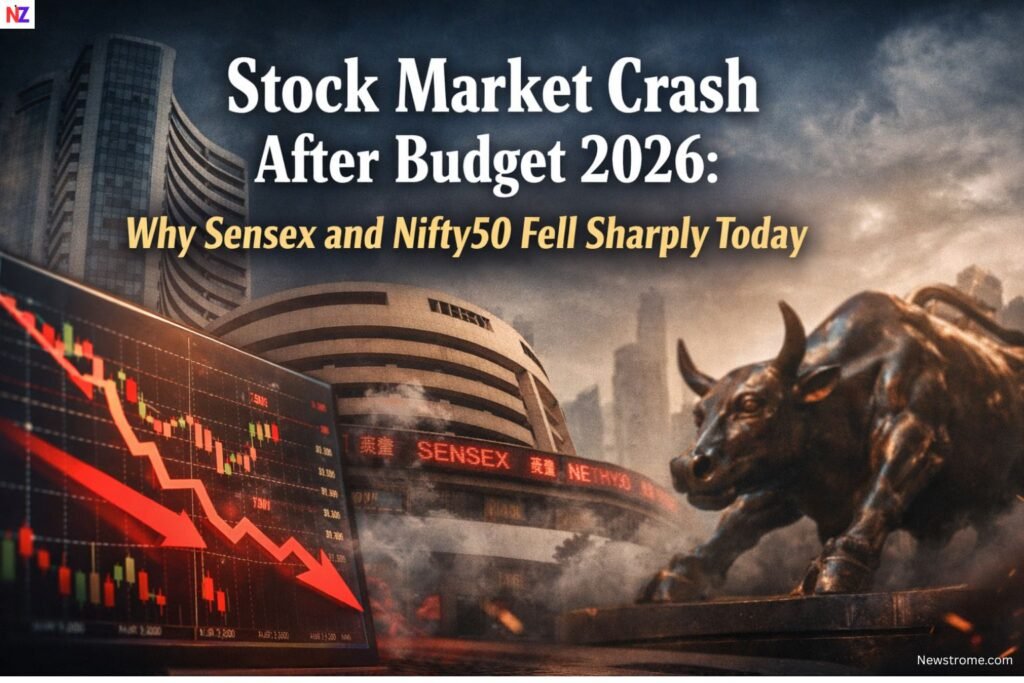
Indian stock markets witnessed a sharp sell-off on Sunday following Finance Minister Nirmala Sitharaman’s Union Budget 2026 speech, as higher transaction taxes rattled investor sentiment. Both benchmark indices — the BSE Sensex and Nifty50 — slipped over 1% during the special Budget trading session, erasing early gains and triggering broad-based losses across sectors.
The Nifty50 briefly slipped below the 25,000 mark, while the Sensex plunged more than 1,600 points intraday before seeing mild recovery. The sudden reversal caught investors off guard, especially after expectations of tax relief had lifted markets ahead of the Budget.
What triggered the stock market crash today?
During her Budget speech, Sitharaman announced:STT on futures increased to 0.05% from 0.02%STT on options premium raised to 0.15% from 0.1%STT on options exercise increased to 0.15% from 0.125%Markets had largely priced in hopes of capital gains tax relief, but the absence of any such announcement, combined with higher trading costs, triggered a knee-jerk reaction.
According to market experts, even small increases in STT significantly impact active traders, arbitrageurs, and hedgers, making derivatives trading less attractive.
Brokerage and exchange stocks lead the fall
Stocks linked to trading and market activity bore the brunt of selling pressure.BSE Ltd dropped to an intraday low of ₹2,517Angel One slipped below ₹2,300The sell-off reflected concerns that higher STT could reduce derivatives volumes, directly impacting revenues for exchanges and brokerage firms.
Heavyweights add pressure on benchmarks
The decline was not limited to trading-related stocks. Index heavyweights also dragged markets lower:Reliance Industries fell around 2.5%State Bank of India (SBI) declined nearly 5%The combined weakness in financials, energy stocks, and brokerages intensified losses on headline indices.
Broader market under stress
Risk aversion dominated trading across the broader market
Market participants noted that equities were already dealing with volatility, and the abrupt rise in transaction costs added to existing concerns.
What does higher STT mean for markets?
Industry leaders believe the government’s move is aimed at curbing excessive speculative trading, particularly in the derivatives segment.
Shripal Shah, Managing Director and CEO of Kotak Securities, said the steep increase in STT could dampen trading activity. He noted that higher impact costs may discourage participation, leading to lower volumes, which could offset any additional tax revenue.
Investor outlook after Budget 2026
While the Budget remains supportive of infrastructure, manufacturing, and digital growth, near-term sentiment has weakened due to tax-related disappointments.
Experts advise investors to:Avoid aggressive short-term tradesStay selective and focus on quality stocksMaintain defensive allocations amid volatilitySectors with stronger policy visibility and long-term potential include railways, electronics, semiconductors, pharmaceuticals, metals & mining, and data centers.
With no relief on long-term or short-term capital gains tax and higher STT weighing on sentiment, foreign institutional investor (FII) selling may continue in the near term.
Bottom line
The stock market crash after Budget 2026 was driven less by fundamentals and more by policy surprises and cost-related concerns. While volatility may persist in the short run, long-term investors are advised to stay diversified, avoid panic decisions, and focus on structural growth themes as markets adjust to the new tax landscape.