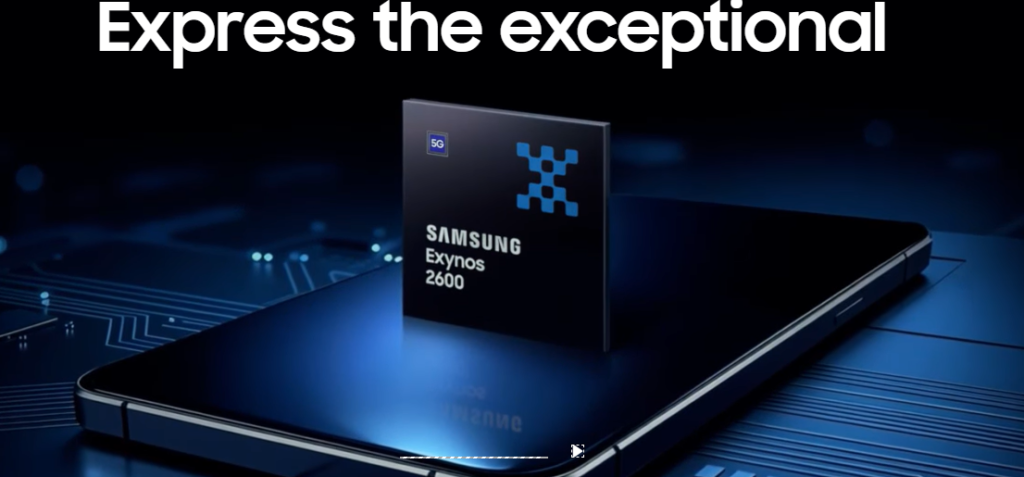
Samsung has officially taken a massive leap forward in mobile chipset technology with the announcement of the Exynos 2600, its most advanced smartphone processor to date. Developed by Samsung Foundry, this new flagship-grade System-on-Chip (SoC) is being hailed as the world’s first mobile chipset built on a 2nm process node, marking a historic milestone in the semiconductor industry.
Designed specifically for premium Galaxy smartphones, the Exynos 2600 is expected to make its commercial debut in early 2026, most likely inside the Galaxy S26 series.An another dive to the Samsung Future packs. With major improvements in AI performance, gaming, power efficiency, and thermal management, Samsung appears determined to reclaim its position at the top of the mobile silicon race.
Exynos 2600: A Major Breakthrough in 2nm GAA Technology

At the heart of the Exynos 2600 lies Samsung Foundry’s cutting-edge 2-nanometre Gate-All-Around (GAA) fabrication process. This next-generation manufacturing technology allows transistors to be wrapped on all sides, significantly reducing power leakage while boosting overall efficiency and performance.
- Compared to previous nodes, the 2nm GAA process enables:
- Higher transistor density
- Improved power efficiency
- Better thermal stability
- Increased computing performance
Samsung claims this technology plays a key role in delivering smoother AI workloads, faster gaming, and longer battery life on upcoming Galaxy devices.
CPU Architecture: Built for Speed and Efficiency

The Exynos 2600 features a custom eight-core CPU configuration, developed entirely in-house by Samsung. The core layout is carefully balanced to handle both peak performance tasks and everyday efficiency.
CPU Core Configuration:
- 1× C1-Ultra core clocked at up to 3.8GHz for heavy workloads
- 3× C1-Pro cores running at 3.25GHz for sustained performance
- 6× C1-Pro efficiency cores capped at 2.75GHz for power-saving operations
- This architecture ensures faster app launches, smoother multitasking, and improved responsiveness across demanding applications.
Samsung also confirms support for LPDDR5X RAM and UFS 4.1 storage, ensuring blazing-fast memory access and storage speeds on flagship Galaxy smartphones.
Xclipse 960 GPU: Next-Level Mobile Gaming Performance

The Samsung Xclipse 960 GPU, a deca-core graphics processor built on the ARM v9.3 architecture, powers the Exynos 2600’s graphics capabilities. High refresh rate displays, console-level effects, and sophisticated gaming images are all supported by this GPU.
Principal GPU Improvements:
- Compared to Exynos 2500, ray-tracing performance is up to 50% greater.
- Enhanced performance in displaying AAA mobile games
- Advanced shadows, reflections, and lighting support
Additionally, Samsung has included Exynos Neural Super Sampling (ENSS) technology. By cleverly upscaling resolution and creating frames, this AI-powered technology improves frame rates and visual quality while providing better gaming without depleting the battery.
AI and NPU: A Big Leap in On-Device Intelligence
Artificial intelligence is one of the biggest focus areas of the Exynos 2600. The chipset comes with a powerful 32K MAC Neural Processing Unit (NPU) that is tightly integrated with the CPU and GPU.
Samsung claims:
- 113% improvement in generative AI performance over Exynos 2500
- Faster on-device AI tasks such as image generation, voice recognition, and real-time translation
The chip also supports ARM Scalable Matrix Extension 2 (SME2), an advanced instruction set that significantly accelerates AI and machine learning workloads. According to Samsung, this enhancement delivers up to 39% higher CPU computing performance while maintaining better power efficiency.
Advanced Thermal Management with Heat Pass Block
Exynos chipsets have often been criticized for heating issues, and Samsung appears to have addressed this head-on. The Exynos 2600 introduces a new thermal solution called Heat Pass Block technology.
This system:
- Optimizes heat-transfer pathways within the chip
- Improves heat dissipation efficiency
- Reduces thermal resistance by up to 16%
- Samsung claims the solution performs on par with a dedicated heat sink, helping maintain stable performance during gaming, video recording, and AI-heavy tasks.
Camera, Display, and Multimedia Capabilities
The Exynos 2600 is built to easily manage next-generation camera and display technology.
Support for Cams:
- 320MP single-camera sensor
- 64MP and 32MP dual camera configuration
- 30 frames per second, 108MP video capture
- 30 frames per second encoding and decoding of 8K video
Support for Displays:
- Maximum quality of 4K or WQUXGA
- Refresh speed of up to 120 Hz
- Smooth images for daily use, gaming, and streaming
The Exynos 2600 is now ready for ultra-high-resolution photography and immersive multimedia consumption thanks to these features.
Post-Quantum Security: Built for the Future
Another important feature of Samsung’s new flagship processor is security. Hybrid Post-Quantum Cryptography (PQC) supported by hardware is a feature of the Exynos 2600.
This innovation provides:
- Protection with ROM roots
- Defense against potential risks posed by quantum computing
- Improved data security for prolonged device use
- Samsung is marketing the Exynos 2600 as a future-proof platform for safe mobile computing since cyber threats are changing quickly.
Exynos 2600 vs Exynos 2500: What’s Improved?
Compared to its predecessor, the Exynos 2600 delivers improvements across nearly every category:
- Over 2x generative AI performance boost
- Significant gains in gaming and ray tracing
- Better thermal efficiency
- Higher CPU and GPU performance
- Improved power management with 2nm GAA
These upgrades signal Samsung’s renewed focus on making Exynos competitive with other top-tier flagship chipsets.
Expected Launch and Galaxy S26 Integration
Samsung has confirmed that the Exynos 2600 will begin rolling out in early 2026, with strong indications that it will power select variants of the Galaxy S26 series.
If real-world performance matches Samsung’s claims, the Exynos 2600 could mark a turning point for the company’s in-house silicon strategy and redefine flagship Android performance.