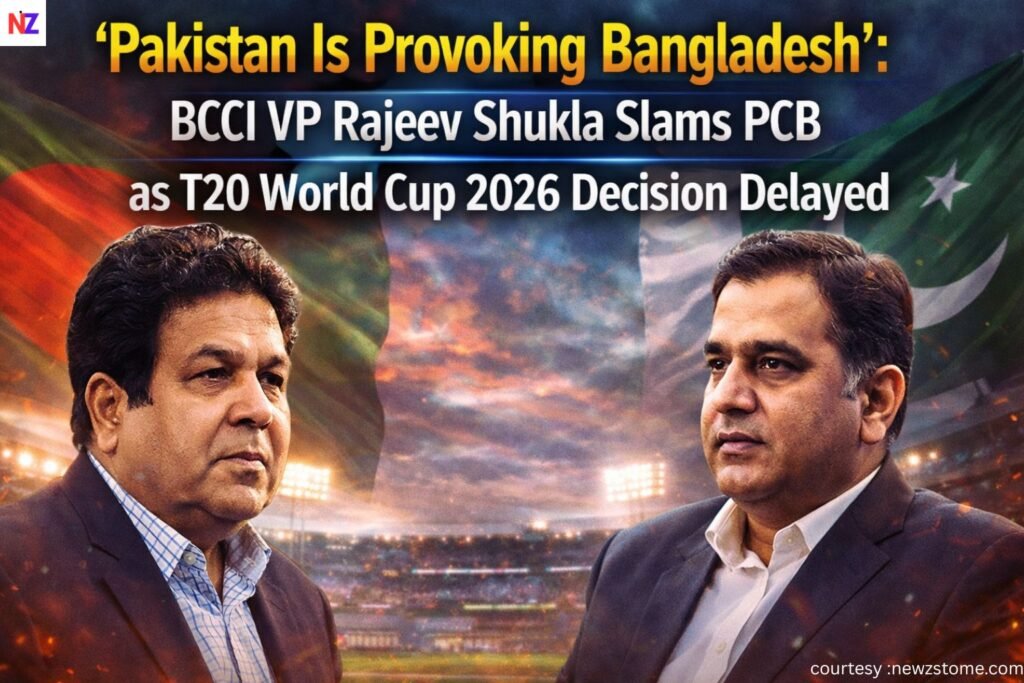
The uncertainty surrounding the ICC Men’s T20 World Cup 2026 deepened on Monday after BCCI vice-president Rajeev Shukla strongly criticised Pakistan, accusing it of provoking Bangladesh and misleading Dhaka over security concerns related to matches scheduled in India.
Speaking to news agency ANI, Shukla alleged that Pakistan’s interference played a key role in Bangladesh’s decision to refuse playing its World Cup fixtures in India — a development that eventually led to Scotland being drafted into the tournament at short notice.
BCCI Insists Bangladesh Was Given Full Security Assurances
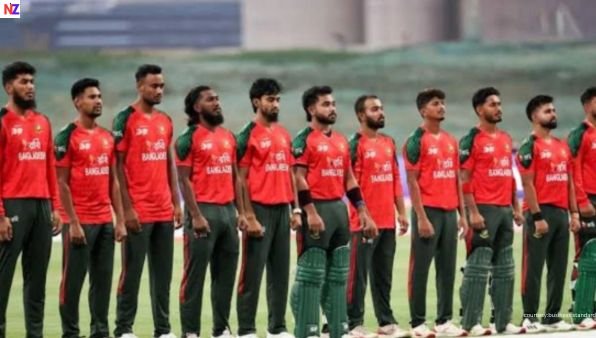
. According to Rajeev Shukla, India went the extra mile to ensure Bangladesh felt comfortable, but the situation took a turn due to outside influence late in the process.
Shukla explained that Indian authorities had offered complete security guarantees and remained open to resolving any remaining issues. However, once Bangladesh opted out, there was little room to rework the tournament schedule at such a late stage.
Shukla Takes Aim at Pakistan’s Involvement
Shukla did not hold back while addressing Pakistan’s role in the episode, accusing the PCB of stepping into the matter unnecessarily and influencing Bangladesh’s stance.
He alleged that Pakistan’s intervention only complicated an already sensitive situation and described the move as irresponsible. Shukla’s remarks, referencing historical tensions between Pakistan and Bangladesh, have added another layer of strain to cricketing relations in the region.
The strong comments come at a time when geopolitical undercurrents are once again threatening to disrupt international cricket, particularly in South Asia.
Pakistan Yet to Confirm Its Own Participation
Ironically, while Pakistan questioned Bangladesh’s decision, its own involvement in the T20 World Cup remains uncertain. PCB chairman and Pakistan’s Interior Minister Mohsin Naqvi had earlier indicated that Islamabad might reconsider participating in the tournament following Bangladesh’s withdrawal from matches in India.
Reports from Pakistani media suggest that Naqvi initially hinted at a possible pull-out before later pushing back the final decision. After meeting Prime Minister Shahbaz Sharif, Naqvi said the matter would be reviewed further, with a final call expected within a week.
Describing the discussions as constructive, Naqvi stated that the prime minister had advised officials to keep all options open. He later confirmed via social media that a decision would be announced either by Friday or early next week.
Squad Named Despite Ongoing Uncertainty
Adding to the intrigue, Pakistan announced its 15-member squad for the tournament just a day after the initial uncertainty surfaced. The announcement raised questions, particularly as local reports claimed the PCB was also considering skipping the high-profile February 15 match against India, citing political sensitivities.
During an ICC Board meeting, Pakistan supported Bangladesh’s position, pointing to the precedent set during last year’s Champions Trophy, when India played its matches in Dubai due to security concerns in Pakistan. However, the ICC reportedly stood firm, emphasising the importance of preserving the tournament’s structure and fairness.
ICC Determined to Avoid Late Disruptions
With broadcast agreements finalised and teams already deep into preparations, the ICC appears reluctant to reopen scheduling discussions. Officials are understood to be focused on protecting the tournament’s stability while allowing diplomatic channels to work quietly in the background.
At present, India and Sri Lanka remain committed as hosts, while Bangladesh’s absence from matches in India and Pakistan’s delayed call continue to dominate the build-up to the tournament.
With the opening match less than two weeks away, clarity is expected soon. Until then, the T20 World Cup 2026 stands as another reminder that in this part of the world, cricket and geopolitics are rarely far apart.