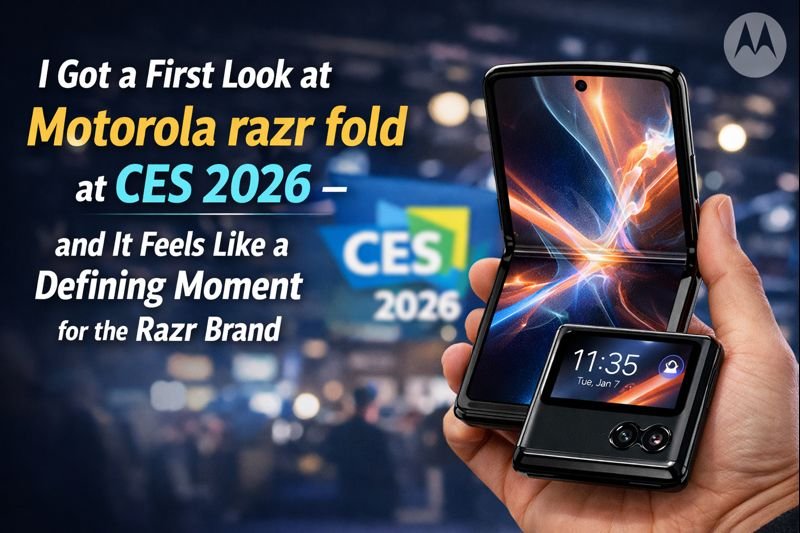
For years, Motorola’s razr name has been closely tied to flip phones. From the nostalgia of the original razr to the modern clamshell foldables, the company carved out a loyal following in a niche that values compactness, style, and practicality. At CES 2026, however, Motorola made it clear that it’s ready to expand that legacy in a much bigger way.
The Motorola razr fold, unveiled in preview form at CES, marks the brand’s first-ever book-style foldable. It’s a bold move—one that signals Motorola’s ambition to compete in a space dominated by a few well-established players. While many details are still under wraps, the early hands-on experience already suggests this device could be a turning point for the razr lineup.
This isn’t just a razr that flips open. It’s a razr that unfolds into something entirely new.
A Foldable That Feels Complete Even When Closed
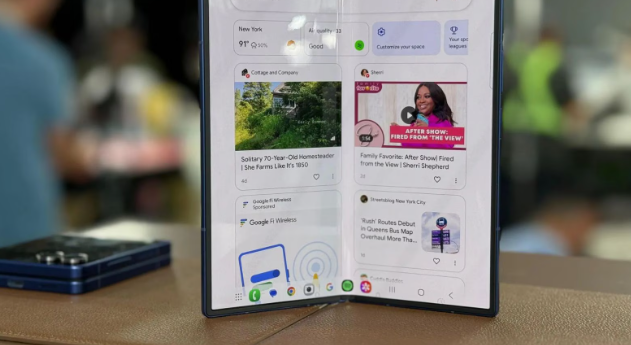
One of the most striking aspects of the Motorola razr fold is how normal and usable it feels when shut. Unlike some book-style foldables that treat the outer display as an afterthought, Motorola has clearly designed the 6.6-inch external screen to stand on its own.
In everyday use, the cover display behaves like a traditional flagship phone. You can check notifications, respond to messages, browse social feeds, use maps, and even handle productivity tasks without feeling like you’re missing out. That alone makes the razr fold feel more practical than many early-generation foldables.
The slim profile helps too. When folded, the phone doesn’t feel bulky or awkward in the pocket. Motorola seems to have prioritized balance and ergonomics, ensuring the device doesn’t feel like a compromise just because it folds.
This approach makes a strong first impression: the razr fold isn’t asking you to adapt to it—it’s adapting to how you already use your phone.
Opening Up Reveals the Real Magic
Unfold the device, and the experience changes dramatically.
Inside, the razr fold opens into a large 8.1-inch 2K LTPO display, instantly shifting the phone into tablet territory. This inner screen feels expansive, immersive, and purpose-built for multitasking. It’s the kind of display that makes you want to open multiple apps, edit documents, watch videos, or sketch ideas without feeling constrained.
The transition from the outer display to the inner screen is smooth and intuitive. Content scales naturally, and the larger canvas invites you to do more than you would on a standard smartphone.
What really stands out is Motorola’s decision to support the moto pen ultra stylus on both displays. This adds a layer of versatility that goes beyond casual consumption. Whether you’re jotting down notes, marking up documents, or sketching ideas, the stylus support makes the razr fold feel like a serious productivity tool—not just a flashy foldable.
Hinge and Crease: Quietly Well Executed
Foldable phones live and die by their hinge, and Motorola seems to understand that deeply.
The hinge on the razr fold feels solid, smooth, and confidence-inspiring. Opening and closing the device doesn’t produce any unpleasant resistance or crunchiness. Instead, there’s a controlled, fluid motion that suggests careful engineering rather than a rushed design.
While the phone isn’t completely gapless when folded, it comes impressively close. The slight gap doesn’t detract from the overall aesthetic, and the folded profile still looks sleek and modern.
As for the crease on the inner display, it’s handled well. You can see it when the screen is off or at certain angles, but once content is on display, it largely fades into the background. During regular use, your eyes naturally stop noticing it, which is exactly how a foldable should behave.
Camera Hardware That Aims High
Motorola is clearly positioning the razr fold as a premium device, and the camera setup reflects that ambition.
On the rear, the phone features a triple 50MP camera system. The main camera uses a Sony LYTIA sensor, though Motorola hasn’t revealed the exact model yet—suggesting there may still be tuning or positioning decisions underway.
Complementing the main sensor is a 50MP ultra-wide camera for landscapes and group shots, along with a 50MP 3x periscope telephoto lens. That telephoto inclusion is especially noteworthy, as it gives the razr fold real versatility for portrait photography and distant subjects.
Selfie cameras are split between the two displays:
- A 32MP camera on the external display, ideal for high-quality selfies using the large cover screen as a viewfinder
- A 20MP camera on the inner display, designed for video calls and content creation when the phone is unfolded
This dual-camera approach ensures the experience feels consistent regardless of how you’re using the device.
Thoughtful Materials and Distinctive Colors
Motorola has always leaned into design identity, and the razr fold continues that tradition.
The phone is available in PANTONE Blackened Blue and PANTONE Lily White, two finishes that give the device very different personalities. One feels deep, refined, and understated, while the other leans lighter and more minimalist.
Both versions feature a textured matte back, which adds grip and resists fingerprints. It’s a small detail, but one that makes the phone feel more premium and secure in the hand.
The overall build feels deliberate and confident—less like an experiment, and more like a product Motorola truly believes in.
Software and the Big Unknowns
Motorola hasn’t shared full details about the chipset, battery size, or pricing yet, which leaves some important questions unanswered. That said, the early software experience appears well-optimized for folding transitions, multitasking, and stylus input.
If Motorola can pair this hardware with a powerful processor, strong battery life, and long-term software support, the razr fold could be a very compelling alternative to existing book-style foldables.
A New Direction for Razr
What’s most exciting about the Motorola razr fold isn’t just the hardware—it’s what it represents.
For the first time, the razr brand is stepping beyond clamshell nostalgia and into the broader foldable conversation. This device feels like Motorola saying, “We’re ready to play on a bigger stage.”
While we’ll need a full review to judge performance, durability, and camera quality, the early CES preview already leaves a strong impression. The razr fold feels refined, thoughtfully designed, and genuinely useful—not just a concept meant to turn heads.
Final Thoughts: A Promising Start for Motorola’s Book-Style Future
The Motorola razr fold may still be wrapped in mystery when it comes to launch timing and final specifications, but one thing is clear: this is not a half-hearted attempt.
From the practical outer display and expansive inner screen to the solid hinge, stylus support, and versatile camera system, the razr fold feels like a carefully considered leap forward.
If Motorola gets the pricing and execution right, this could be the device that finally brings the razr name into the mainstream foldable conversation—without losing the personality that made it iconic in the first place.
For now, it’s one of the most intriguing foldables we’ve seen at CES 2026—and a strong sign that Motorola’s foldable journey is only just beginning.