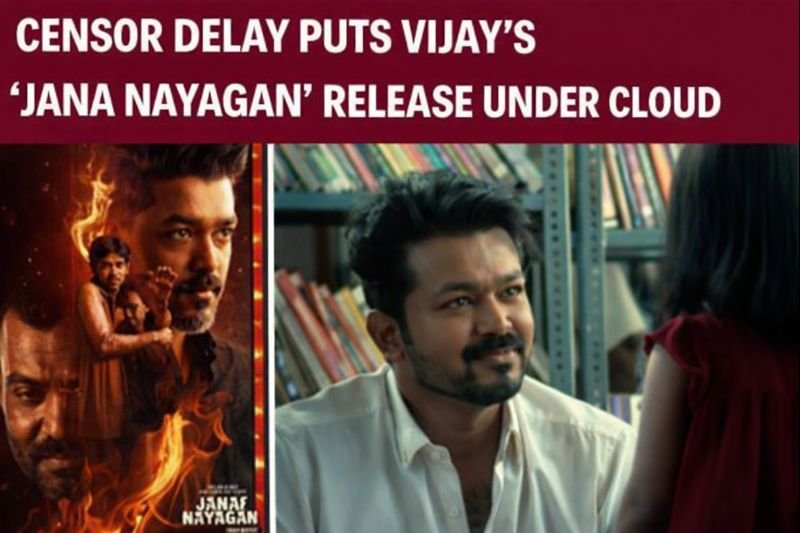
If you’re a fan of Tamil superstar Vijay, or even just follow Indian cinema, you’ve probably heard the buzz—and the confusion—around his latest (and reportedly last) film, Jana Nayagan. Scheduled to hit screens on January 9th, 2026, the release has now been suddenly postponed. Social media is swirling with rumours, and a legal battle is playing out in the Madras High Court. Let’s unpack this whole situation step by step, in plain, simple terms.
The Build-Up: A Blockbuster in Waiting
First, understand the context. Vijay isn’t just an actor; he’s a phenomenon. Any film of his is a major event, and Jana Nayagan carries extra weight because it’s being promoted as his final acting project before he shifts full-time to politics. Directed by H. Vinoth and with a cast including popular names like Prakash Raj and Pooja Hegde, the film has been riding a massive wave of anticipation. The producers, KVN Productions, had everything lined up: the film was completed, a big release date was announced, and fans worldwide were marking their calendars. The final, crucial step was getting that green light from the censor board.
The Stumbling Block: The Censor Certificate Tangle
In India, every film needs a certificate from the Central Board of Film Certification (CBFC)—what we commonly call the censor board. This board watches the film and suggests cuts or changes if they feel content is too violent, offensive, or could disturb public order. The goal is to assign a rating: U (for all), UA (parental guidance for children under 12), or A (adults only).
The Jana Nayagan team submitted their film on December 18th. The next day, a committee from the CBFC watched it. They reportedly said some scenes and dialogues needed to be removed or muted. The filmmakers, as is common practice, made those changes. Normally, that’s it—certificate granted, and the film is cleared for release.
But here’s where things got unusual. After the changes were made, the certificate didn’t come. Instead, the process came to a halt. Why? Because one member of the initial viewing committee raised a specific complaint, stating that certain scenes (14 of them, according to reports) could “hurt religious sentiments.” This complaint triggered a rule that allows the CBFC to send the film to a higher authority—the Review Committee—for a second, more thorough look. So, the film’s fate was put on hold, stuck in bureaucratic limbo despite the team believing they had complied with all the initial notes.
The Legal Hail Mary: A Run to the Courthouse
With the release date just days away and millions of dollars in marketing and theatre bookings on the line, the producers panicked. They couldn’t just wait indefinitely. So, they took the CBFC to court. Their argument was straightforward: “We did what you asked. One person’s complaint shouldn’t derail the entire process, especially when a release date is fixed. Give us our certificate.”
The case landed before Justice P.T. Asha in the Madras High Court. The judge wanted to see this mysterious complaint, asking the CBFC to present it. During the hearing, the government’s lawyer (the Additional Solicitor General) explained the board’s position. He stated that the CBFC has every right to send a film for review if concerns emerge later, and that’s what they were doing. It was a classic clash: the filmmakers’ urgency versus the bureaucracy’s cautious procedure.
On January 8th, after hearing both sides, the judge reserved her order. This is a legal term meaning she’s heard all arguments and will now take some time to think and write her final judgment. She didn’t give an immediate ruling, nor did she set a date for when she would. This created a state of complete uncertainty.
The Inevitable Delay: “Unforeseen Circumstances”
Stuck between a pending court order and a censor board that hadn’t budged, the release became impossible. You can’t legally screen a film in India without that censor certificate. The distributors, particularly the international ones, had to act.
This brings us to that official announcement from Malik Streams Corporation, the Malaysian distributors, on social media. Their message, citing “unforeseen circumstances,” was the first official confirmation of the delay. It was a carefully worded note, essentially saying: “Stop. We’re hitting pause. We don’t have a new date yet. Please don’t believe rumours, and bear with us.” The phrase “unforeseen circumstances” is a polite veil over the perfect storm of legal and certification delays happening behind the scenes.
The Big Picture: What Does It All Mean?
So, where does this leave us?
The Court’s Call: Everyone is now waiting for Justice Asha’s written order. Will she direct the CBFC to issue the certificate immediately? Will she ask the Review Committee to fast-track its decision? Or will she allow the CBFC to follow its own timeline? Her decision will break the logjam.
The Review Committee’s Role: Parallelly, the CBFC’s Review Committee will be watching the film, focusing on those 14 flagged scenes. They will decide if the cuts already made are sufficient, or if more edits are needed to secure a UA certificate (which the producers want to reach the widest family audience).
A Waiting Game: The entire project is now in a holding pattern. Theatres will need to reschedule. Massive promotional campaigns have screeched to a halt. Most importantly, millions of disappointed fans are left wondering when they’ll see their favourite star’s swansong.
In Human Terms...
Imagine planning a gigantic, once-in-a-lifetime party. The hall is booked, the invitations are sent, the food is ordered. Then, at the last minute, a local official says your party permit needs a second signature from a department head who’s on leave. You run to a higher authority to complain about the delay, but they say they’ll “think about it.” So, you have no choice but to text all your guests: “Party postponed. Sorry. We’ll tell you the new date when we can.”
That’s essentially the story of Jana Nayagan. It’s a collision of movie star frenzy, administrative protocols, sensitive content concerns, and legal recourse. For now, all the fans, the filmmakers, and the industry can do is exactly what the distributors asked: stay patient, avoid rumours, and wait for the courts and the censor board to decide the film’s fate. The show, quite literally, cannot go on until they do.