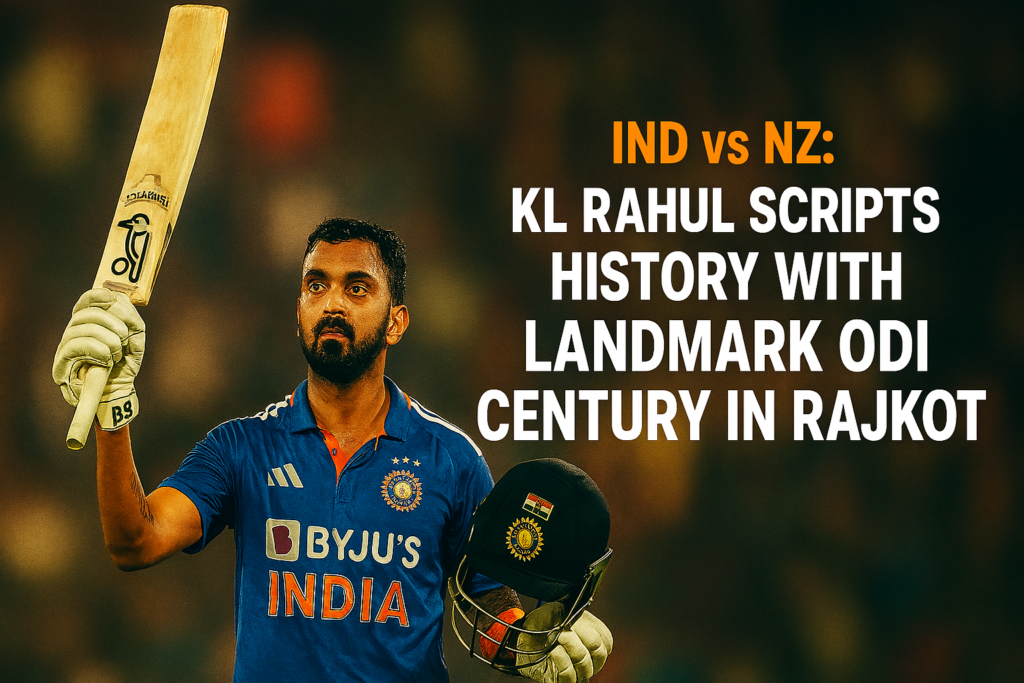
KL Rahul once again underlined his importance to India’s ODI setup with a composed, match-defining century against New Zealand in the second ODI at the Niranjan Shah Stadium, Rajkot. The unbeaten knock was not just crucial in the context of the match, but also historic in nature. Rahul became the first Indian wicket-keeper to score an ODI century against New Zealand and the first Indian batter to score an ODI hundred at this venue, adding another significant chapter to his international career.
Batting at No. 5, Rahul showed patience, maturity, and clarity of role as India posted a competitive total of 284 for seven after being put in to bat. His innings stood out not for flamboyance, but for control — a quality that has increasingly defined his ODI batting in recent years.
A Century Built on Responsibility
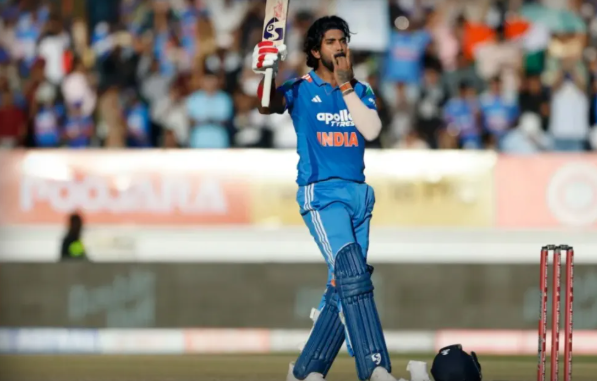
Rahul’s knock of 112 not out off 87 balls came at a time when India needed stability. He began cautiously, failing to score off his first six deliveries before opening his account on the seventh ball. The early phase was about assessment rather than aggression, especially with the pitch offering variable bounce.
India suffered a setback when Virat Kohli was dismissed for 23, leaving the middle order under pressure. That moment demanded composure, and Rahul responded by anchoring the innings without slowing it down excessively. His ability to rotate strike and pick boundaries at the right time kept the scoreboard ticking.
The century came in the 49th over, when Rahul dispatched a full toss from Kyle Jamieson over the ropes for a six. It was a fitting way to reach the landmark — calm, calculated, and decisive. His innings included 11 fours and one six, reflecting a balanced approach rather than brute force.
Crucial Partnerships Shape the Innings
One of the defining aspects of Rahul’s innings was his partnerships. He added 73 runs with Ravindra Jadeja, who contributed 27 before being dismissed. That stand helped India recover from a slightly tricky phase and regain momentum through the middle overs.
After Jadeja’s departure, Rahul continued to guide the innings alongside Nitish Kumar Reddy, ensuring India did not lose direction. While wickets fell at the other end, Rahul remained unfazed, focusing on taking the game deep — a strategy that paid off handsomely.
His presence allowed the lower order to play with freedom in the final overs, pushing India to a total that proved challenging on the surface.
Consistency Against New Zealand
Rahul’s performance was not an isolated effort. His record against New Zealand in ODIs has been outstanding, with an average of over 93 against the opposition. That consistency reflects his adaptability and understanding of New Zealand’s bowling patterns, whether facing pace or spin.
Earlier in the series, during the first ODI in Vadodara, Rahul played a brief but impactful role. He scored 29 off 21 balls, sealing the chase in the 49th over with two fours and a six as India secured a four-wicket win. Across both matches, his contributions have come in different forms but with the same level of impact.
A Defined Role in India’s Middle Order
Rahul’s evolution into a dependable middle-order batter has added balance to India’s ODI lineup. Whether rebuilding after early wickets or batting through the innings, he has shown the ability to read situations and adapt his tempo accordingly.
His role at No. 5 has become increasingly vital, especially in matches where India need a stabilizing presence. In Rajkot, that responsibility was on full display, as he ensured India remained competitive throughout the innings.
Match Context and Team Updates
Earlier in the day, New Zealand captain Michael Bracewell won the toss and opted to bowl first. India entered the match with a 1–0 lead in the three-match series following their Vadodara victory.
. New Zealand brought in left-arm spin all-rounder Jayden Lennox, while India were forced into a change after Washington Sundar suffered a rib injury and was ruled out of the remainder of the series. Nitish Reddy replaced Sundar in the XI, and Ayush Badoni was added to the squad for the remaining matches.
The third and final ODI will be played in Indore on Sunday, where India will look to build on Rahul’s form and seal the series.
A Knock That Defined the Match
KL Rahul’s century in Rajkot was more than a personal milestone. It was an innings that reflected experience, discipline, and leadership — qualities that continue to make him one of India’s most reliable ODI batters. In a format that often rewards aggression, Rahul once again proved the value of composure and game awareness.