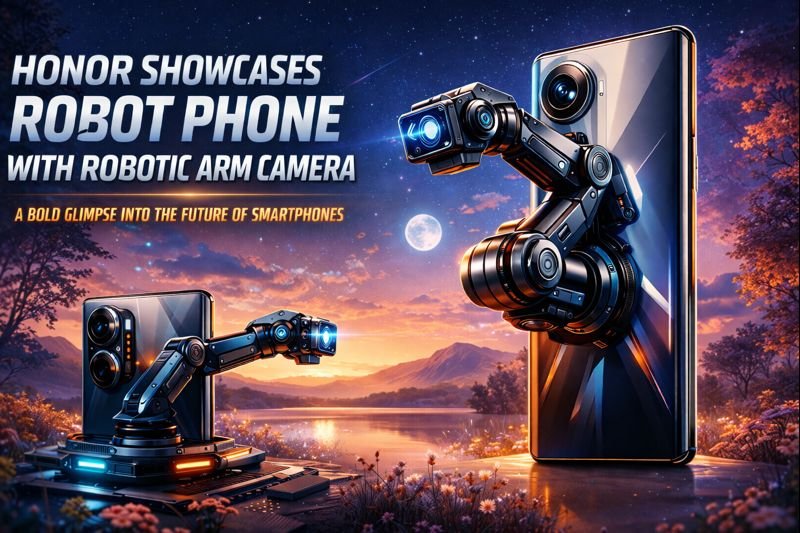
Innovation in smartphones has become increasingly incremental. Bigger batteries, brighter displays, faster processors — useful upgrades, yes, but rarely surprising. Every once in a while, though, a concept appears that genuinely makes you pause and rethink what a phone can be.
Honor’s newly showcased Robot Phone, revealed publicly at CES 2026, is one of those moments.
Instead of relying on digital stabilization or fixed camera modules, Honor is experimenting with something far more ambitious: a mechanical, robotic camera gimbal built directly into the phone. It’s a design that feels part science fiction, part filmmaking tool — and, surprisingly, not just a gimmick.
While the device is still a prototype and not yet ready for consumer use, Honor has confirmed that the Robot Phone will be officially launched at Mobile World Congress (MWC) 2026, with sales expected to begin shortly after.
This isn’t just another concept phone destined for a glass display case. Honor appears serious about making this product real.
A Smartphone That Moves — Literally
At first glance, the Honor Robot Phone looks like a premium smartphone with a noticeably thick camera island. Look closer, and the surprise reveals itself.
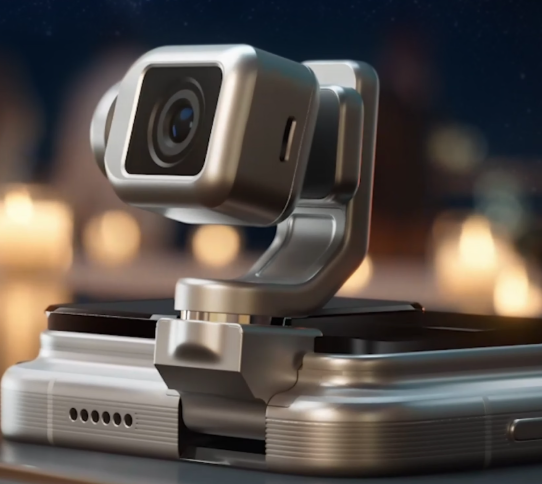
Instead of a static rear camera, the phone houses a robotic arm-mounted camera module that physically moves. When activated, the camera extends outward from the body, stabilizing itself in real time — much like a professional gimbal or a compact filmmaking device such as the DJI Osmo Pocket.
This articulated arm isn’t for show. It is designed to:
- Actively counter hand movement
- Maintain horizon leveling
- Track subjects automatically
- Deliver Steadicam-style footage without external accessories
In simple terms, the camera doesn’t just rely on software to steady your video — it physically balances itself.
For creators, vloggers, and anyone who records a lot of video on their phone, that’s a potentially game-changing shift.
Engineering That Defies Expectations
Seeing the Robot Phone in person makes one thing immediately clear: this should not fit inside a smartphone — yet it does.
Honor has managed to compress the gimbal motor, articulated arm, sensors, and protective mechanisms into a surprisingly compact space. When not in use, the entire assembly folds neatly into the phone’s body, sealed by an automatic shutter designed to protect it from dust and accidental damage.
The internal cavity where the gimbal rests is larger than most camera modules, hinting at how aggressively manufacturers have miniaturized other components like batteries, cooling systems, and circuit boards.
Honor engineers have also added ventilation cutouts on the rear panel — a strong sign that thermal management is a priority, especially with moving parts and motors generating heat during extended filming sessions.
Still a Prototype — But a Serious One
Honor is transparent about the Robot Phone’s current status. While the design language and mechanical concept are largely finalized, key specifications are still under development.
Details yet to be confirmed include:
- Camera sensor size
- Resolution and lens aperture
- Battery capacity and efficiency
- Long-term durability of moving parts
- Performance under continuous recording
During CES demonstrations, the device was not yet available for hands-on testing. However, the company’s willingness to show internal hardware and mechanical components signals confidence rather than caution.
This is not vaporware.
Why a Physical Gimbal Matters in 2026
You might reasonably ask: Do we really need a mechanical gimbal when smartphone cameras already shoot stable video?
That question gets to the heart of Honor’s experiment.
Digital stabilization — even at its best — works by cropping frames, compensating with software, and making predictive guesses. A physical gimbal, on the other hand, reacts instantly and naturally to movement, preserving:
- Full sensor resolution
- Natural motion blur
- Better low-light stability
- More cinematic camera movement
In challenging conditions — walking shots, handheld vlogging, dynamic action scenes — mechanical stabilization still outperforms software solutions.
Honor’s idea is simple but bold: bring professional-grade stabilization directly into the phone, eliminating the need for extra gear.
Smart Software Meets Moving Hardware
The Robot Phone isn’t just about hardware innovation. Honor is also exploring how software can take advantage of a camera that can move independently.
One early demo showcased subject tracking while the phone lay flat on a surface. The camera automatically followed a person moving around the room — a feature that could be invaluable for:
- Solo content creators
- Fitness instructors
- Fashion creators using outfit-checking tools
- Video calls and presentations
Honor has hinted at AI-powered features that work hand-in-hand with the gimbal, such as automated framing, posture correction, and smart scene transitions.
This blend of robotics and artificial intelligence could open use cases we haven’t fully imagined yet.
Design Trade-Offs and Practical Concerns
As exciting as the Robot Phone looks, it raises important questions — and Honor knows it.
A moving camera module introduces concerns around:
- Long-term durability
- Dust and water resistance
- Repair complexity
- Added weight and thickness
Honor’s solution includes a protective shutter and reinforced arm design, but real-world use will be the true test. Smartphones are dropped, stuffed into pockets, and exposed to unpredictable conditions.
There’s also the question of cost. Advanced mechanical systems are not cheap, and the Robot Phone is unlikely to be a budget device.
Still, innovation has never been inexpensive.
Consumer Reaction: Divided but Curious
Early reactions to the Robot Phone concept have been split.
Some users see it as unnecessarily complex, arguing that modern smartphone cameras are already “good enough.” Others view it as the most exciting camera innovation in years — a genuine leap rather than a marginal upgrade.
That division may actually work in Honor’s favor. The Robot Phone isn’t trying to replace every smartphone. Instead, it targets a specific audience that values creative control, video quality, and experimental design.
Launch Timeline: What We Know So Far
Here’s what’s confirmed:
- Official launch: MWC 2026 (March)
- Sales window: Likely April–May 2026
- Status: Final hardware nearing completion
- Hands-on units: Expected closer to MWC
If Honor delivers on its promises, the Robot Phone could become one of the most talked-about devices of the year.
A Risk Worth Taking
In an industry often accused of playing it safe, Honor’s Robot Phone feels refreshingly bold.
Will it succeed? That depends on execution, pricing, and reliability. But one thing is certain: Honor is pushing smartphone design forward in a way few brands are willing to attempt.
Even if the Robot Phone doesn’t become a mainstream hit, it sets a precedent — reminding the industry that innovation doesn’t have to stop at thinner bezels or faster chips.
Sometimes, the camera really does need to move.