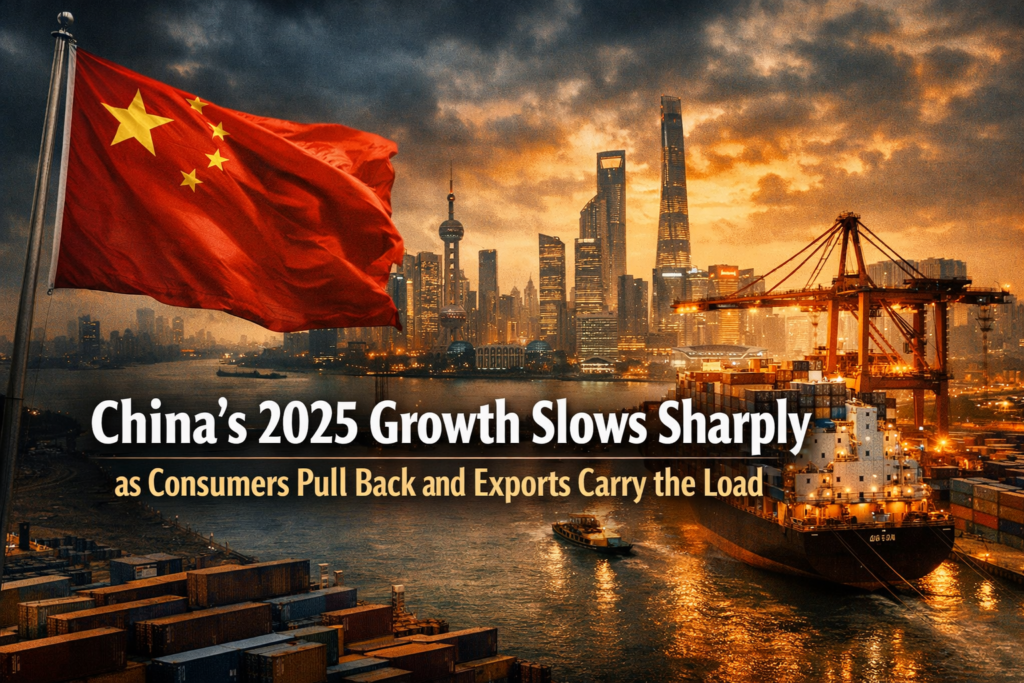
China’s economy expanded by 5% in 2025, one of its weakest growth performances in decades, highlighting the growing strain on domestic demand even as exports continue to provide support. While the figure matched Beijing’s official target, economists and ordinary citizens alike say it fails to capture the unease felt across the country.
In Shanghai, tourist Yang Qing summed up the mood simply: “Everyone is thinking harder about their spending under these poor economic conditions.” That cautious sentiment is becoming increasingly common as households face job insecurity, falling property values, and uncertain income prospects.
Growth Meets the Target, But Momentum Fades

Official data released on Monday showed that economic activity slowed noticeably toward the end of the year. Growth in the final quarter dropped to 4.5%, underscoring the difficulty policymakers face in reigniting momentum.
National Bureau of Statistics official Kang Yi acknowledged the challenges, pointing to worsening global conditions and persistent domestic imbalances. Strong supply paired with weak demand remains a major concern, he said, adding that both long-standing structural problems and new risks are weighing on development.
Although authorities can technically claim success by hitting the “around 5%” target, analysts argue the number acts more as political reassurance than a true reflection of economic health.
Consumers Stay Cautious Despite Stimulus
Consumer spending continues to lag. Retail sales growth slowed to 3.7% in 2025, down from the previous year, and December saw a particularly weak rise of just 0.9%, the slowest pace since China lifted its strict zero-Covid controls in late 2022.
The fading impact of government subsidies for household goods is partly to blame. While trade-in schemes encouraged spending earlier in the year, their influence appears to be wearing off.
Officials say more measures are on the way. Policies aimed at removing restrictions on consumption and extending appliance replacement incentives are expected to continue into 2026. However, economists warn that confidence, not incentives alone, will determine whether consumers open their wallets again.
Exports Keep Factories Running
Industrial output grew 5.9% last year, only slightly below 2024 levels. December production showed modest improvement, driven largely by resilient overseas demand.
Manufacturing data offered a rare bright spot. China’s purchasing managers’ index edged up to 50.1 in December, finally moving back into expansion territory after months below the key threshold.
Yet analysts caution that this strength is export-led rather than demand-driven. “Output growth picked up late in the year, but exports are doing most of the heavy lifting,” said Zichun Huang of Capital Economics, who expects growth in 2026 to soften further.
Property Sector Remains a Drag
China’s once-booming property market continues to struggle. Fixed-asset investment declined 3.8% in 2025, reflecting a pullback after years of aggressive construction and infrastructure spending.
The prolonged debt crisis in the sector has eroded household wealth and remains a major obstacle to recovery.
Trade War Pressures and a Record Surplus
Adding to China’s challenges was the return of Donald Trump to the White House, reigniting trade tensions between the world’s two largest economies. Although Chinese exports to the US plunged 20%, demand from other regions helped cushion the blow.
China posted a record $1.2 trillion trade surplus, driven by strong shipments to Southeast Asia, Africa, and Europe. Exports to ASEAN rose 13.4%, African markets surged 25.8%, and sales to the EU climbed 8.4%.
For some, the export boom has translated into personal optimism. Shanghai-based trader Wang Dongdong said his business performed well enough for him to buy a new car and plan a trip abroad. “I think 2026 will be better than 2025,” he said, citing improving global trends.
The Road Ahead
China’s economy is no longer experiencing growth that comes easily. Although exports are helping to buy some time, low consumer confidence and difficulties in the property market continue to pose significant challenges. The ability of policy makers to rebuild trust within the country could be crucial in determining whether the world’s second-largest economy can recover and strengthen in the coming years.