
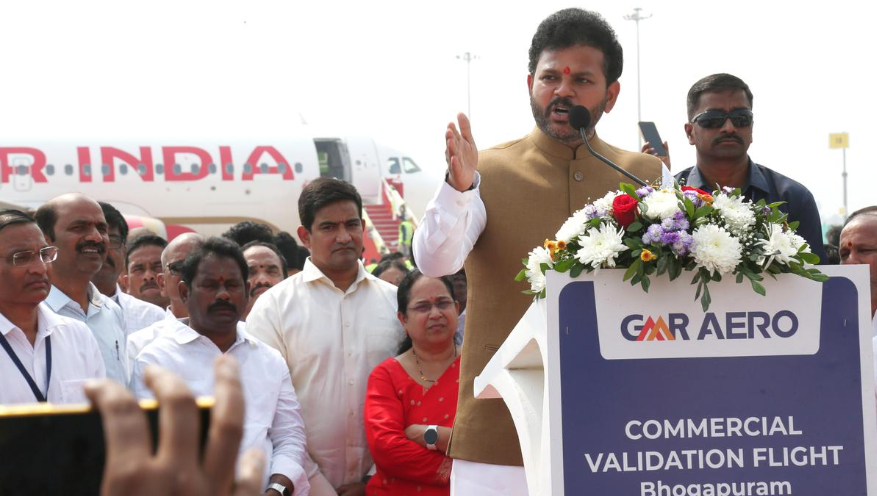
The Union government is planning a major change in India’s aviation policy by permitting two or more airports to function in major cities. This initiative aims to handle the swiftly increasing number of air travelers across the nation. The announcement was made by Union Minister for Civil Aviation, Kinjarapu Rammohan Naidu, during his visit to Vizianagaram district in Andhra Pradesh on Sunday.
The minister made this statement following the successful first commercial validation flight at the Alluri Sitharama Raju International Airport in Bhogapuram, which is located near Visakhapatnam.
While addressing the media, Mr. Rammohan Naidu stated that the government would evaluate the current policy, which limits the operation of two airports within a 150-kilometre radius.
“With the demand for air travel increasing every year, the government acknowledges the need to update outdated policies.
The restriction on having two airports operating within a 150-kilometre radius will be reconsidered for the benefit of the public,” he added.
Rising Passenger Numbers Forcing Policy Reassessment
India has witnessed an unprecedented surge in air travel over the past few years. Domestic passenger traffic has consistently crossed pre-pandemic levels, while international travel is also recovering strongly. Major airports in metropolitan cities such as Delhi, Mumbai, Bengaluru, and Chennai are increasingly facing congestion during peak hours.
According to aviation experts, single-airport systems in large urban regions are no longer sufficient to handle rising demand, particularly as air travel becomes more accessible to middle-income households. The government’s move to allow multiple airports within a city is expected to ease congestion, reduce delays, and improve overall passenger experience.
New Airports Planned Across Major Urban Centres
Replying to questions from journalists, Mr. Rammohan Naidu said the Centre is already moving ahead with plans to build new airports in several key cities. These include a second airport for Mumbai, the upcoming airport at Ghaziabad in Uttar Pradesh, which is around 42 kilometres from New Delhi, as well as new facilities planned for Bengaluru, Parandur near Chennai, and other fast-growing regions.
“The government will approve proposals for new airports when existing airports begin to reach saturation levels,” the minister said, adding that infrastructure planning must stay ahead of passenger growth.
The Ghaziabad airport, also known as Jewar Airport, is expected to significantly reduce the burden on Delhi’s Indira Gandhi International Airport, one of the busiest airports in Asia.
Aviation Sector a Strategic Priority
Mr. Rammohan Naidu reiterated that the aviation sector has been accorded top priority by the Union government due to its role in driving economic growth. He noted that airports act as catalysts for trade, tourism, and investment, while also generating employment on a large scale.
In addition to airport construction, the government is actively promoting Maintenance, Repair and Overhaul (MRO) facilities across the country. Strengthening the MRO ecosystem will help reduce India’s dependence on foreign facilities, lower operational costs for airlines, and create high-skilled technical jobs domestically.
“The development of airports and MRO facilities together will ensure both economic expansion and employment generation, directly and indirectly,” the minister said.
Learning From Past Infrastructure Success Stories
During his address, Mr. Rammohan Naidu referred to the Rajiv Gandhi International Airport at Shamshabad in Telangana as an example of successful long-term infrastructure planning. Developed over nearly 5,000 acres, the airport has grown into one of India’s most efficient aviation hubs.
He credited the project to the initiative taken by N. Chandrababu Naidu during his tenure as Chief Minister of the erstwhile unified Andhra Pradesh between 1995 and 2003.
“The Shamshabad airport stands as proof that visionary planning in aviation can deliver lasting economic benefits,” the minister said.
Focus on Airport Connectivity and Access Roads
The Civil Aviation Minister also stressed the importance of developing multiple access roads to airports, stating that aviation infrastructure cannot function in isolation. Efficient road and transport connectivity, he said, plays a vital role in ensuring seamless passenger movement and supporting industrial growth around airport zones.
“Airports generate economic activity far beyond their boundaries. Good connectivity enhances industrial development, logistics efficiency, and real estate growth in surrounding regions,” he explained.
Bhogapuram Airport Seen as Growth Engine for Andhra Pradesh
Mr. Rammohan Naidu expressed confidence in the future of the Bhogapuram International Airport, viewing it as a transformative project for Andhra Pradesh. He mentioned that the airport will play a significant role in boosting economic development, particularly in the North Andhra region.
He further said, “The Bhogapuram airport will strengthen trade connections, boost export activities, and unlock the tourism potential of Andhra Pradesh.
It will also create numerous job opportunities for the local community.”
The airport is strategically located to improve transportation links for Visakhapatnam and nearby areas, making the region more attractive to both investors and tourists.
Optimism From State Government and Industry
Andhra Pradesh Minister for MSMEs Kondapalli Srinivas echoed the Union minister’s views, stating that the new international airport would accelerate industrial growth and support small and medium enterprises in the region.
Meanwhile, GMR Group – Airports Business Chairman G.B.S. Raju expressed confidence that the Bhogapuram airport would emerge as a major aviation hub in eastern India. He said the project would significantly enhance regional connectivity and contribute to balanced development across Andhra Pradesh.
A Broader Shift in India’s Aviation Strategy
The Centre’s willingness to allow multiple airports within major cities reflects a broader shift in India’s aviation strategy—from capacity management to long-term growth planning. As passenger numbers continue to rise and air travel becomes an integral part of everyday mobility, flexible infrastructure policies are becoming increasingly necessary.
With several new airports under construction and existing ones undergoing expansion, India’s aviation landscape is poised for rapid transformation. The proposed policy review could mark a turning point in how urban air connectivity is planned, ensuring that infrastructure keeps pace with the country’s economic and demographic growth.