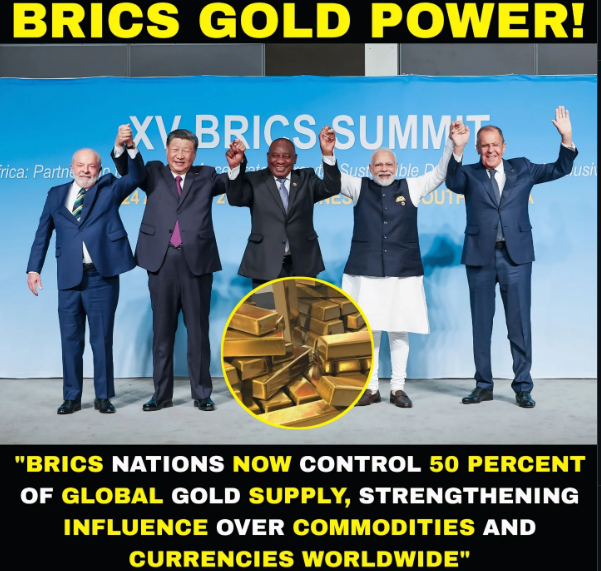
Think about money for a second. Most of it is digital now, just numbers on a screen. It’s backed by trust in a government or a bank. But gold? Gold is different. It’s a physical thing. You can hold it. It’s been valued by every culture for thousands of years because it’s rare, durable, and pretty universal. When countries or people get nervous about the future of paper money, they turn to gold. It’s the ultimate fallback, a safety net that doesn’t rely on any single country’s promise.
What BRICS Is Actually Doing
BRICS is a club of major emerging economies: Brazil, Russia, India, China, and South Africa. Their move is pretty straightforward but smart. They’re doing two things at once.
First, they are producing a huge chunk of the world’s new gold. Between them and their friendly nations, they’re involved in about half of all the gold mined each year. But instead of selling all that gold to the West for dollars, they’re keeping a lot of it. They’re stuffing it into their own national vaults.
Second, they are buying gold like crazy on the open market. Their central banks have been the world’s most active shoppers for gold bars over the past few years. So they’re not just keeping their own stuff; they’re actively using their existing cash (a lot of which is US dollars) to buy even more gold from elsewhere.
This dual move is like deciding to both grow your own vegetable garden and buy up all the vegetables at the local market. You’re securing your own supply and making sure others have less access to it.
The Wake-Up Call That Started It All
This shift didn’t come out of nowhere. The real turning point was the war in Ukraine. When that started, Western nations froze the foreign currency reserves that Russia held in their banks and financial systems. Overnight, Russia couldn’t access a huge pile of its own money.
For the rest of the world, especially countries that sometimes disagree with the West, this was a massive shock. It was a lesson: “If you cross us politically, the money you’ve parked in our system isn’t safe. We can lock you out.” That scared a lot of governments. It made them realize that holding vast reserves in dollars or euros is a risk. Gold, sitting in your own basement vault, can’t be frozen by someone else. That lesson is the engine behind this whole BRICS strategy.
So, What Does This Mean for the US Dollar?
This is the heart of your question. Is the dollar about to crash and burn? No, not anytime soon. It’s still the world’s most used currency. But think of its power like a giant, slow-moving ship. The BRICS move is like water slowly leaking into the hull. It’s a slow erosion, not a sudden hole.
Here’s how that erosion works:
Fewer Dollars in the Piggy Bank: Countries hold dollars as reserves to pay for international stuff and to support their own currency. As BRICS countries swap dollars for gold, they are slowly reducing the portion of their savings held in dollars. This means less overall global demand for dollars just sitting around in reserves.
Trading in Their Own Backyard: These countries do a lot of business with each other—about 30% of world trade. They are increasingly making these deals in their own money. China pays Brazil in Chinese Yuan, India pays Russia in Rupees. When they do this, they don’t need to use dollars as the middleman. Each of these small deals is a tiny bypass around the dollar highway.
Building a Plan B: The long-game idea is to create an alternative system. A giant shared pool of gold could, one day, be used to back a new BRICS trade token or to support a network of their own currencies. This wouldn’t replace the dollar for everyone, but it would offer a solid option for countries wanting out of the dollar-centric system, especially if they fear sanctions.
It's Not Just About the Gold, Though
The experts point out that the real kingpin propping up the dollar is oil. For decades, almost all global oil sales have been in dollars—the “petrodollar” system. Because everyone needs oil, everyone needs dollars.
BRICS is nudging at that too. By trading energy and other goods in local currencies, and by China heavily investing in electric cars and solar power (to need less oil in the long run), they’re trying to loosen the dollar’s grip on the world’s most critical resource. This is a game measured in decades, not years.
The Roadblocks for BRICS
Let’s be real, this isn’t easy. Turning a pile of gold into a functioning alternative to the dollar is a monster task. These countries have their own rivalries and different economic needs. Agreeing on the rules for a gold-backed system would be a diplomatic nightmare. Also, the US economy and its financial markets are still the biggest, most stable game in town. Trust in the dollar wasn’t built in a day and won’t disappear in one.
The Bottom Line
BRICS controlling half the world’s gold is a giant statement.
For the US dollar, it means the days of its total, unquestioned dominance are slowly coming to a close. We’re headed for a world with more than one financial center of gravity. The dollar will likely remain the single most important currency for a long time, but it won’t be the only important one. Gold is making a comeback as the silent bedrock in the background, and other currencies are getting room to grow.