India‘s trade data for November 2025 delivered a welcome and robust rebound, marking a dramatic shift from the concerning figures recorded just a month prior. After exports contracted and the trade deficit widened to a record high in October, November’s numbers showed strong, across-the-board improvement.
A Sharp Reversal in Fortunes
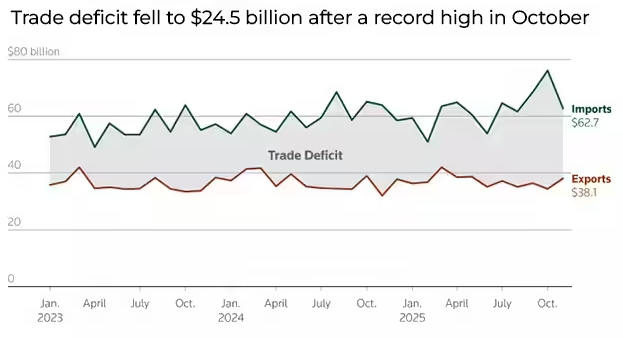
Government data released in mid-December revealed that merchandise exports surged by 19.37% year-on-year to reach $38.13 billion. This vigorous growth was instrumental in pulling the country’s trade deficit—the gap between what we import and what we export—down to $24.53 billion, its lowest point in five months. This swift turnaround has provided significant relief to policymakers and businesses alike, signaling resilience in the face of global economic headwinds.
The Twin Engines of Recovery: Soaring Exports and Softer Imports
The narrowing of the trade deficit was powered by positive movements on both sides of the ledger. On the export front, the growth was broad-based and led by high-value sectors. Shipments of engineering goods and electronics goods were particularly strong drivers, reflecting improving global demand and the success of domestic production-linked incentive schemes. Other key sectors like pharmaceuticals and gems & jewellery also contributed to the upward momentum. Commerce Secretary Rajesh Agrawal aptly termed November “a good month for exports,” noting that it helped offset the previous month’s weakness and indicated improved momentum.
Equally important was the moderation on the import side. Total imports dipped by 1.88% to $62.66 billion in November. This decline wasn’t about cutting back on essential industrial inputs but was primarily due to a significant reduction in the inbound shipments of gold, crude oil, coal, and coke. The softening of global commodity prices and a correction from earlier stockpiling, especially in gold, played a key role in easing the import bill. This combination of higher exports and restrained imports created the perfect conditions for the trade deficit to contract sharply from October’s record $41.68 billion.
Resilience Amidst Challenges: The U.S. Market and Diversification
A particularly noteworthy aspect of November’s performance is the continued strength of exports to the United States. Despite the imposition of additional tariffs earlier in the year, the U.S. remained India’s top export destination during the April-November period of the fiscal year. S.C. Ralhan, President of the Federation of Indian Export Organisations (FIEO), highlighted this, pointing to the resilience and adaptability of Indian exporters who have navigated a complex tariff landscape. This ability to retain a key market under pressure is a testament to the competitiveness of Indian goods.
Beyond the U.S., strategic market diversification has been a cornerstone of recent export strategy. Major destinations like the United Arab Emirates (UAE), the Netherlands, China, and the United Kingdom have absorbed growing shares of Indian products. This concerted effort to cultivate and deepen trade relationships with a wider set of partners has built a more resilient export ecosystem, reducing over-reliance on any single economy and opening new avenues for growth.
The Broader Fiscal Year Picture: Growth Amidst a Lingering Gap
While the November snapshot is decidedly positive, the eight-month overview for the current fiscal year (April to November) presents a more nuanced, mixed picture. Cumulative exports for this period have grown by 2.62% to $292.07 billion, demonstrating slow but steady expansion. However, imports have grown at a faster clip of 5.59%, reaching $515.21 billion. This differential has resulted in a cumulative merchandise trade deficit of $223.14 billion for the eight months, which remains elevated. The data underscores that while monthly performances can be strong, the structural gap where import growth outpaces export growth continues to be a focal point for the economy. The strong services export sector, however, continues to provide a crucial offset to the goods deficit.
Looking Ahead: Cautious Optimism
The November surge has undoubtedly injected optimism into India’s trade outlook. Key factors supporting a positive trajectory include continued policy support for manufacturing, improvements in logistics infrastructure, and better access to competitive export finance. As FIEO’s Ralhan suggests, these elements position India’s exports well for the coming months. However, the path forward requires sustained momentum in key sectors, careful monitoring of global demand and commodity prices, and ongoing efforts to enhance export competitiveness. If November’s momentum can be consolidated, it will pave the way for a stronger finish to the fiscal year and a healthier trade balance.

Ghananand is the Founder & Chief Editor of NewzStrome. Hailing from Prayagraj, Uttar Pradesh, he brings 1.5 years of hands-on experience in journalism and digital media. He delivers sharp, unbiased, and timely news from India and across the globe. Passionate about investigative reporting, technology, politics, and lifestyle, Ghananand is committed to bringing readers nothing but the truth