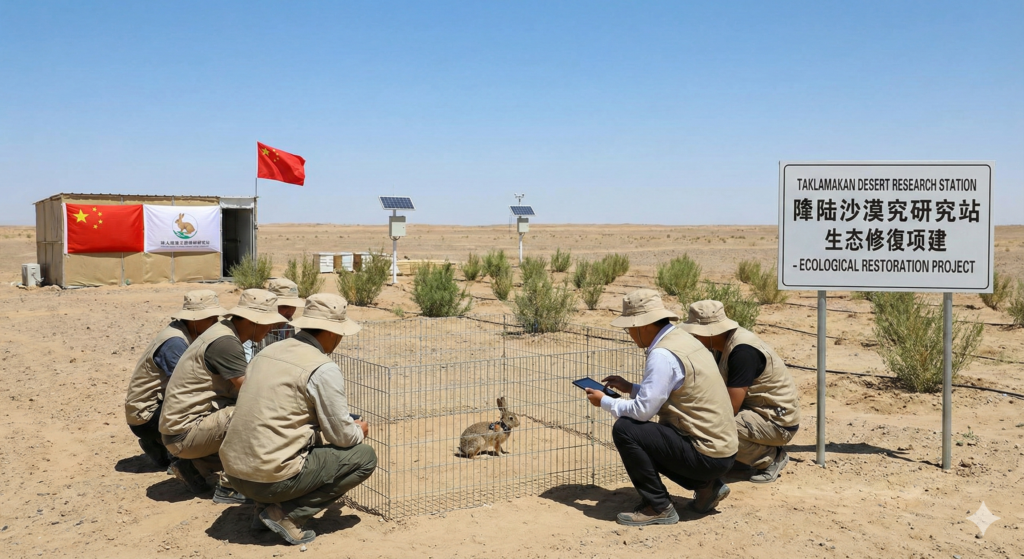
China has long faced one of the world’s most severe desertification crises. Vast stretches of land, particularly in Inner Mongolia, Xinjiang, and Gansu, have been swallowed by expanding deserts. This threatens agriculture, water security, and the livelihoods of millions. In response, China has experimented with unconventional ecological engineering projects. One of the most striking ideas reported is the release of over one million rabbits into desert regions to help restore ecosystems. While unusual, the logic behind this initiative reflects China’s willingness to test bold, nature-based solutions.
Why Rabbits?
At first glance, rabbits may seem like an odd choice for desert restoration. However, their biological behavior makes them surprisingly useful in degraded landscapes:
- Soil Aeration: Rabbits dig burrows, loosening compacted desert soil. This allows rainwater to seep deeper and seeds to germinate more effectively.
- Seed Dispersal: As rabbits forage, they spread plant seeds through droppings, helping vegetation re-establish.
- Microhabitats: Burrows create cooler, moister micro-environments that can shelter insects and small plants, kickstarting biodiversity.
- Food Chain Revival: Rabbits attract predators such as foxes and birds of prey, gradually rebuilding a balanced ecosystem.
In essence, rabbits act as “ecosystem engineers,” reshaping barren land into more habitable terrain.
Benefits of the Rabbit Release
The potential advantages of this experiment are significant:
- Cost-Effective Restoration: Compared to large-scale irrigation or tree-planting, rabbits are a low-cost biological solution.
- Rapid Soil Improvement: Their digging accelerates soil turnover, mimicking natural processes that would otherwise take decades.
- Vegetation Recovery: By dispersing seeds and fertilizing soil with droppings, rabbits encourage plant growth.
- Biodiversity Boost: The presence of rabbits can attract other species, helping deserts regain ecological balance.
- Community Engagement: Such projects often involve local farmers, who benefit from reduced sandstorms and improved grazing land.
Risks and Controversies
Despite the promise, the rabbit release is not without risks:
- Overpopulation: Rabbits reproduce rapidly. Without predators, they could overwhelm fragile vegetation, worsening desertification.
- Competition with Native Species: Rabbits may outcompete local herbivores for scarce food resources.
- Ecological Imbalance: Introducing non-native or uncontrolled populations can destabilize ecosystems.
- Disease Spread: Large rabbit populations could spread parasites or diseases to other animals.
- Uncertain Long-Term Impact: While short-term soil aeration is beneficial, the long-term sustainability of rabbit-driven restoration remains unclear.
This duality—potential benefits versus ecological risks—makes the project highly controversial among scientists.
The Bigger Picture: China’s Desertification Battle
The rabbit release is only one piece of China’s broader war against desertification. Other strategies include:
- The “Great Green Wall”: A massive tree-planting campaign stretching thousands of kilometers to block desert expansion.
- Sand Fixation Projects: Using straw grids and chemical sprays to stabilize dunes.
- Water-Saving Irrigation: Introducing drip irrigation to grow crops in arid zones.
- Alternative Livelihoods: Encouraging locals to shift from grazing to eco-tourism or sustainable farming.
China’s willingness to experiment with rabbits reflects its pragmatic approach: try multiple methods, scale up what works, and abandon what fails.
Global Comparisons
China’s rabbit experiment can be compared to other desert restoration efforts worldwide:
- Israel: Pioneered drip irrigation, turning deserts into productive farmland.
- Africa’s Great Green Wall: A pan-African project planting trees across the Sahel to halt desert spread.
- Australia: Ironically, rabbits there are considered pests, causing ecological damage. This highlights how context matters—what is destructive in one ecosystem may be beneficial in another.
Such comparisons show that desert restoration is not one-size-fits-all. Each region must adapt strategies to its unique ecological and cultural context.
Conclusion
The release of one million rabbits into China’s deserts is a daring ecological experiment. Rabbits, as natural soil engineers, could help aerate land, disperse seeds, and revive ecosystems. Yet the risks of overpopulation and ecological imbalance are real. Whether this project succeeds or fails, it symbolizes China’s determination to confront desertification with creativity and scale.

Ghananand is the Founder & Chief Editor of NewzStrome. Hailing from Prayagraj, Uttar Pradesh, he brings 1.5 years of hands-on experience in journalism and digital media. He delivers sharp, unbiased, and timely news from India and across the globe. Passionate about investigative reporting, technology, politics, and lifestyle, Ghananand is committed to bringing readers nothing but the truth