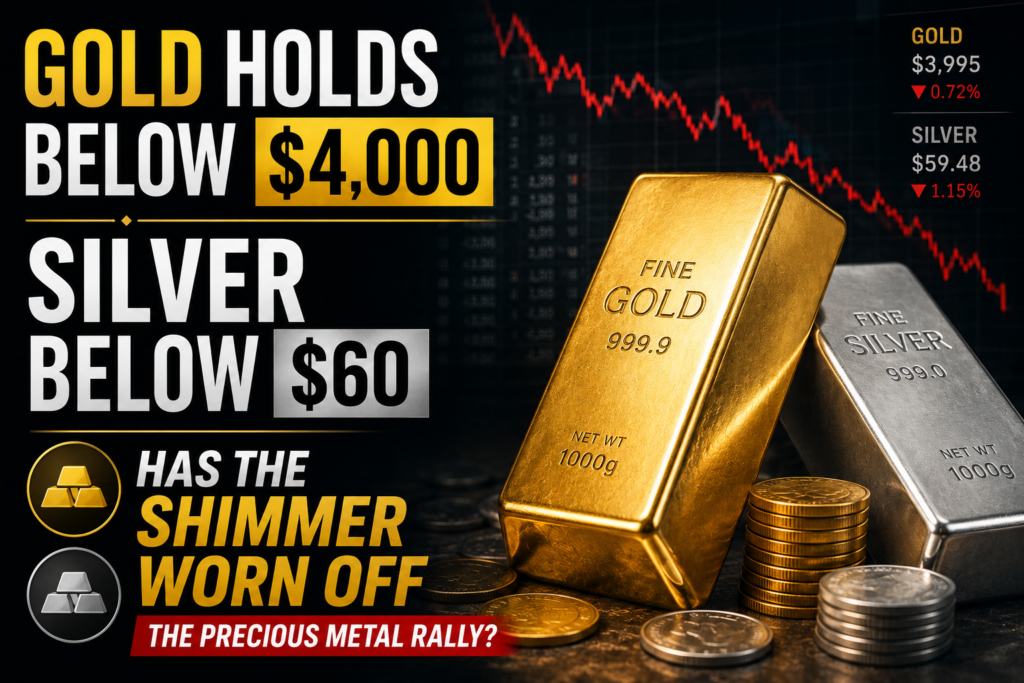
For the better part of three years, gold and silver could do almost no wrong. Every dip was bought, every headline about war or inflation or central bank chaos sent prices higher, and the people who had loaded up on precious metals were sitting pretty watching their portfolios climb in ways that made the stock market crowd look over their shoulders. Then came this week, and the mood shifted dramatically. Gold broke below $4,000 an ounce on June 24, 2026 — its first sustained fall below that level since November 2025 — and silver tumbled under $60 at the same time. The question bouncing around every trading desk and investor group chat right now is the same: is this just a breather, or is the great metals party officially over?
How Far Gold Has Actually Fallen
Let’s put some numbers on the table to understand the scale of what has happened. Gold hit a jaw-dropping all-time high of $5,608 per ounce back in January 2026 — a price that would have seemed laughable to most serious analysts even two years earlier. The metal had been on one of the most relentless upward runs in modern market history, posting double-digit percentage gains for three consecutive years.
From that January peak to where it sits now around $3,972, gold has given back roughly 29% of its value. That is not a minor blip. That is a proper correction, and it has happened fast enough to leave many buyers who got in near the top sitting on significant losses. Silver’s journey has been even more extreme. At its most spectacular, earlier this year, silver briefly traded above $100 an ounce for the first time in history, eventually peaking near $116. It has now fallen to around $58 — a decline of roughly 50% from its peak in just a matter of months.
What Actually Triggered This Drop
There is rarely a single reason why any market moves the way it does, and this week’s selloff in precious metals is no different. Several forces converged at roughly the same time to push prices through key support levels.
The biggest factor is the Federal Reserve and what it is signalling about interest rates. Fed Chair Kevin Warsh, who took over the central bank’s top job this year, has been consistently clear that his priority is fighting inflation, not supporting asset prices. Under his leadership, the Fed has been hinting strongly at raising interest rates rather than cutting them — a complete reversal of the expectations that had been baked into markets for much of 2025. When the CME FedWatch tool showed the probability of a September rate hike jumping from around 29% to roughly 70% in the space of a single week, precious metals traders paid attention immediately. Higher interest rates make gold and silver less attractive because they offer no yield — when you can get a meaningful return just by holding dollars in a safe account, the argument for owning metal weakens considerably.
The second major driver is the US dollar itself. A hawkish Fed tends to push the dollar higher, and that is exactly what has happened. The US Dollar Index climbed to a fresh 13-month high this week. Since gold and silver are both priced in dollars on global markets, a stronger dollar makes them more expensive for buyers in other currencies, which dampens demand and pushes prices lower.
The third factor is more specific and surprising: geopolitics actually helped push prices down rather than up. For most of the past year, tensions in the Middle East — particularly the conflict involving the US, Iran, and Israel — had been one of the key supports underneath the gold price. The outbreak of the US-Iran war in February 2026 had sent safe-haven demand surging. But this week, signals emerged of a potential framework agreement easing that conflict, including specific terms around the Strait of Hormuz. When the war premium starts coming out of gold, the retreat can be sharp.
And finally, there was a more mechanical trigger that many casual observers would miss entirely. A sharp selloff in US technology stocks left some investors facing urgent losses, and they turned to gold as an easy source of liquidity — selling the metal not because they wanted to, but because they needed cash quickly to cover positions elsewhere. That kind of forced selling can accelerate a price move well beyond what the underlying fundamentals would justify on their own.
The Latecomers Are Taking the Most Pain
Here is the uncomfortable truth about market corrections: they rarely hurt the people who got in early. The ones who bought gold at $2,000 or $2,500 or even $3,000 are still sitting on substantial profits even after this pullback. The people feeling genuine pain right now are the ones who piled in near the highs — everyday savers and small investors who saw the metal touching record after record and concluded it could only keep going up. Those buyers are now facing the steepest losses, often at the very moment when the stock markets they chose to avoid have continued climbing to new records. The S&P 500 is up around 11% so far in 2026. Gold is down nearly 30% from its peak. That contrast is genuinely jarring for anyone who chose metals over equities at the worst possible moment.
Meanwhile, one asset has quietly done exactly what a safe haven is supposed to do. The Swiss franc, barely talked about in most investing circles, has been sitting at an 11-year high against the dollar and its strongest level ever against the euro. Sometimes the old boring option is the right one.
Is This a Correction or a Collapse? Most Analysts Say Correction
Strip away the noise and the short-term panic, and the view from most serious analysts is that this is a correction — a meaningful and painful one, but a correction nonetheless rather than the beginning of a permanent decline.
Macquarie’s strategists, for example, are still forecasting an average gold spot price of $4,641 per ounce across 2026 as a whole, which implies a significant recovery from current levels in the second half of the year. They have trimmed their year-end target to $4,300 from $4,400, but that still represents a healthy bounce from where gold is trading today.
JP Morgan’s Global Research team goes even further. Their analysts are projecting gold reaching $6,000 per ounce by the final quarter of 2026 — a target that sounds extraordinary from current prices but reflects their view on where the structural demand story for the metal is headed. They also see $6,300 as a possibility for 2027. For silver, ING has revised down its near-term forecasts but still sees meaningful upside through the second half of the year.
The physical demand picture supports a more cautious optimism as well. Gold-backed exchange-traded funds recorded their strongest weekly inflow since mid-April last week, taking in around $1.1 billion or roughly 5.1 tonnes of metal. That followed four consecutive weeks of outflows. When institutional money starts flowing back into a selloff, it usually signals that large investors see value rather than danger. Total ETF holdings stand at around 4,086 tonnes globally, and cumulative 2026 inflows are still nearly $17 billion positive for the year.
Silver's Structural Story Has Not Changed
Of the two metals, silver’s case for a longer-term recovery is arguably the cleaner one to make. The industrial demand backdrop for silver is unlike anything gold can claim. About 60% of annual silver consumption is tied directly to physical industrial applications — electronics manufacturing, solar panels, and semiconductors are the biggest users. The ongoing global buildout of data centres, the surging power demands driven by artificial intelligence workloads, and the broader electrification of transport and energy infrastructure all feed into silver demand in very concrete ways.
Silver also faces its sixth consecutive year of supply running below demand. Even with prices down sharply from their highs, the fundamental shortfall in the physical market has not gone away. Inventories are thinner than they were, and a structural deficit tends to put a floor under prices even when the speculative enthusiasm cools. Brett Elliott of APMEX noted that silver is currently being pushed in two opposite directions simultaneously — cooling investment demand pulling the price down, while persistent supply shortage pushes it up. That tension does not resolve cleanly in one direction overnight.
Gold's Big Support — Central Banks Are Still Buying
One of the most important developments in precious metals markets over the past few years has been the shift in central bank behaviour. After decades of selling gold to fund other needs, the world’s central banks have become consistent and significant buyers of the metal. The driver is largely diversification — reducing dependence on US dollar reserves, especially among emerging market economies and nations that have become more cautious about holding US Treasuries following the events of recent years.
In 2025, gold overtook US Treasuries as the largest share of global reserves for the first time in 30 years. A 2025 survey found that 95% of central banks expected global gold reserves to continue rising through 2026. That kind of structural, steady demand does not vanish because of one bad week in the spot market. Central banks are not momentum traders. They are long-term buyers, and their demand has historically provided a meaningful floor under gold prices even during sharp corrections.
What Happens Next
The honest answer is that no one knows exactly when gold and silver find their floor and start climbing again. Markets that move on geopolitics, Fed policy, and currency dynamics can turn quickly in either direction. What is reasonably clear is that the conditions which drove the extraordinary rally of 2023 to early 2026 — persistent inflation, central bank buying, geopolitical fear, and dollar weakness — have not permanently disappeared. They have temporarily given way to a hawkish Fed signal, a stronger dollar, and a de-escalation in the Middle East that may or may not prove durable.
If the Fed’s tough stance on rates triggers a slowdown in the US economy, or if geopolitical tensions flare again, or if inflation proves stickier than markets currently expect, the case for owning gold and silver comes roaring back very quickly. Standard Chartered is projecting gold at $5,100 per ounce by mid-2027. That forecast is only achievable if the structural story remains intact — but given everything we know about central bank demand, supply constraints, and the fragile state of global economic stability, it is far from a fantasy.
For now, the market is repricing. The easy trade is over. What comes next will require more patience, more discipline, and a clearer head than the frenzied momentum buying that defined the peaks earlier this year.
*Investment Disclaimer
The information provided in this article is intended for general informational and educational purposes only and does not constitute financial, investment, legal, or tax advice of any kind. The content reflects publicly available market information and analyst commentary as of the date of publication — June 25, 2026 — and is subject to change without notice.
Investing in precious metals, commodities, or any financial instruments carries significant risk, including the possible loss of principal. Past performance of gold, silver, or any other asset is not a guarantee of future results. Price forecasts and analyst projections cited in this article are third-party opinions and should not be relied upon as the basis for any investment decision.
Readers are strongly encouraged to consult a qualified financial advisor, investment professional, or registered broker before making any investment decisions related to gold, silver, ETFs, or any other asset mentioned in this article.
This publication does not hold any position in gold, silver, or related securities and receives no compensation from any financial institution, fund, or commodity provider in connection with this content.

Ghananand is the Founder & Chief Editor of NewzStrome. Hailing from Prayagraj, Uttar Pradesh, he brings 1.5 years of hands-on experience in journalism and digital media. He delivers sharp, unbiased, and timely news from India and across the globe. Passionate about investigative reporting, technology, politics, and lifestyle, Ghananand is committed to bringing readers nothing but the truth