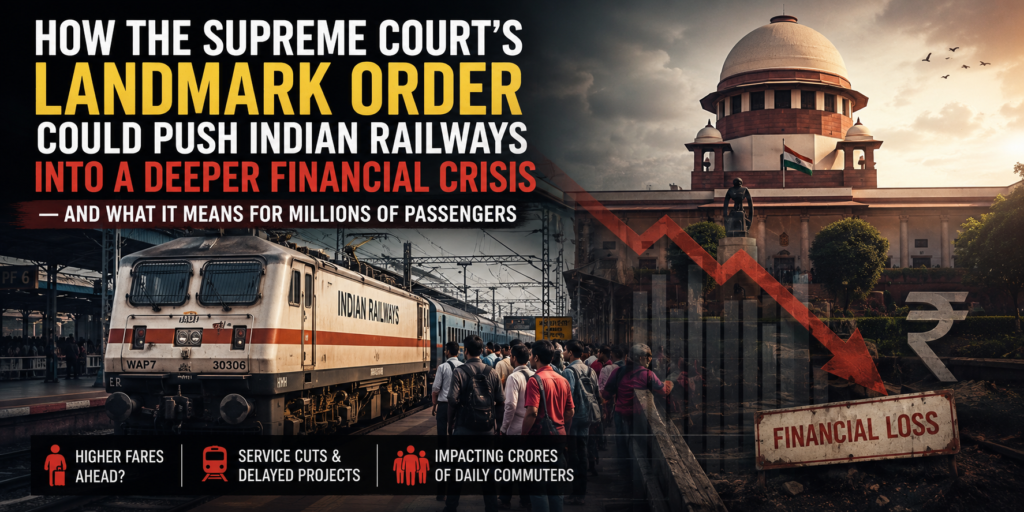
Indian Railways is not just a transport system. It is a lifeline. Every single day, more than 13 million people board trains across the country, trusting a network that has connected cities, villages, families, and economies for over 170 years. But behind the busy platforms and the whistle of departing trains, something troubling is building up quietly — a financial strain that has been growing for years, and now, a Supreme Court order threatens to stretch it even further.
The Financial State of Indian Railways: Already Walking a Tightrope
Enter the Supreme Court: What Did the Order Actually Say?
Before we get to the Supreme Court order, it is important to understand where Indian Railways stands financially right now. The numbers are not pretty.
The operating ratio — which tells us how much money Railways spends to earn every hundred rupees — has been hovering at uncomfortable levels. When this ratio crosses 100, it means Indian Railways is spending more than it earns. In recent years, it has hovered dangerously close to or above 98, which leaves almost no room for savings, investment, or crisis management.
Revenue from passenger traffic, which forms a significant part of income, has not kept up with the cost of running trains. The freight business has been the real backbone, cross-subsidising passenger fares that have been kept artificially low for political and social reasons. But even freight revenues have their limits when infrastructure costs keep climbing.
On top of that, Indian Railways has massive ongoing commitments — hundreds of new Vande Bharat trains, dedicated freight corridors, station redevelopment projects, and track electrification. These are not optional extras. They are essential modernisation projects. But they demand money, and that money has to come from somewhere.
The pension burden alone runs into tens of thousands of crores annually. Employee costs, fuel expenses, and maintenance of an ageing fleet all add to the pressure. Capital expenditure has been rising sharply, funded largely through borrowings and budgetary support from the central government. The Railway’s own internal generation of funds has been shrinking as a proportion of total spending.
Supreme Court In short — Indian Railways is financially stretched, trying to run a world-class network on a budget that keeps falling short.
The Supreme Court of India, in a significant ruling, addressed the issue of land encroachment and compensation related to railway land and properties. The order, broadly interpreted, has implications for how Railways must deal with land disputes, displaced communities, and compensation settlements.
For decades, railway land — spread across thousands of kilometres of track, stations, and depots — has been a subject of legal battles, encroachments, and compensation claims. Supreme Court have periodically stepped in to protect the rights of individuals affected by railway projects, land acquisition, and demolition drives.
This latest order carries weight because it potentially opens the door for a fresh wave of compensation claims. If affected parties — whether slum dwellers near tracks, farmers whose land was acquired, or business owners displaced during expansion — are entitled to revised or enhanced compensation, the financial burden on Railways could be enormous.
Supreme Court Legal experts have pointed out that such an order, if implemented broadly, could lead to hundreds or even thousands of cases being reopened. Each case has a cost. When you multiply that across the entire country and its vast railway geography, the numbers can run into thousands of crores of rupees.
Why This Timing Is Particularly Painful
This is not happening in isolation. The court order comes at a time when Railways is already borrowing heavily to fund its capital projects. The government has set ambitious targets for infrastructure — bullet trains, high-speed corridors, modern stations. These projects carry political weight and public excitement, but they also carry enormous price tags.
Supreme Court Adding a new layer of legal liability — one that is hard to predict, hard to cap, and potentially retroactive — into this financial environment is genuinely dangerous. Unlike a new project cost that can be planned and budgeted, compensation orders are reactive. You cannot always see them coming, and you often cannot delay payment once ordered by a court.
There is also a human resource angle. Handling thousands of legal cases requires manpower, legal teams, documentation, and time. Every rupee and every hour spent on litigation is a rupee and hour not spent on improving services or safety.
What Does This Mean for the Ordinary Passenger?
Here is where it gets real for most people. When Railways faces a financial squeeze, the consequences trickle down.
Deferred maintenance becomes a real risk — when budgets are tight, non-urgent repairs get pushed back. This affects safety over time. Investment in new amenities, cleaner coaches, better food services, and improved station facilities slows down. Freight tariff hikes may become necessary, which then pushes up logistics costs and, eventually, the prices of goods across the economy. Pressure to raise passenger fares — something the government has resisted for years — could finally become unavoidable.
None of these are abstract concerns. They affect real journeys, real commutes, and real household budgets.
Is There a Way Out?
There are no easy answers, but experts consistently point toward a few directions. Railways needs to diversify its revenue streams — commercial development of station land, advertising, logistics parks, and private partnerships can bring in money without burdening passengers. Legal reforms to streamline land dispute resolution would reduce prolonged litigation costs. Greater efficiency in procurement and project execution can reduce wastage. And eventually, a rational revision of passenger fares — done carefully and with protections for the poorest travellers — may become necessary.
The Supreme Court’s role is to uphold rights, and it has done so. But the government and Railways must now figure out how to respond without letting the financial foundation of this massive institution crack further.
Indian Railways has survived partition, wars, floods, and pandemics. It will survive this too. But the road ahead demands honest decisions, not just hopeful promises.
FAQ: Indian Railways Finances and the Supreme Court Order Impact
Q1. What is the current financial condition of Indian Railways?
Indian Railways is under serious financial pressure. Its operating ratio has been hovering close to 98, which means it is spending nearly 98 rupees to earn every 100 rupees. With massive ongoing infrastructure projects, a heavy pension burden, and low passenger fares kept unchanged for social reasons, the railway’s own revenue generation has not been enough to cover its growing expenses. It relies heavily on government budgetary support and borrowings to keep functioning.
Q2. What did the Supreme Court order say about Indian Railways?
The Supreme Court issued a significant ruling related to railway land, encroachments, and compensation for affected communities. The order strengthens the rights of individuals —Supreme Court including farmers, slum dwellers, and displaced families — who have been impacted by railway land acquisition and expansion projects. This opens the possibility of fresh or revised compensation claims being filed across the country, creating new financial liability for Railways.
Q3. How much financial burden could the Supreme Court order add to Indian Railways?
Supreme Court While an exact figure is difficult to predict, legal experts believe that if the order is applied broadly, it could trigger hundreds or thousands of compensation cases nationwide. Given that railway land spans thousands of kilometres across every state in India, the cumulative financial impact could run into thousands of crores of rupees — a significant blow for an organisation already running on a very thin financial margin.
Q4. Why are passenger fares so low in Indian Railways, and is that a problem?
Passenger fares in India have been kept deliberately low for years, largely for political and social reasons, to keep rail travel accessible to the poorest citizens. While this is a well-intentioned policy, it means Railways earns far less from passengers than it actually costs to run those services. The shortfall is mostly covered by charging higher freight rates from goods transporters — a practice known as cross-subsidisation. This model is increasingly unsustainable as costs rise.
Q5. What is the operating ratio, and why does it matter for Indian Railways?
The operating ratio is a key financial measure that shows how much money Railways spends to earn every hundred rupees of revenue. A lower ratio means better financial health. Ideally, it should be well below 90. When it climbs close to or above 98, it signals that almost nothing is left over for savings, safety investments, or emergencies. Indian Railways has been struggling with a high operating ratio for several years, which is a serious warning sign.
Q6. Will the Supreme Court order affect train services or passenger safety?
Supreme Court Not immediately, but indirectly over time, yes. When Railways faces unexpected financial liabilities, it tends to delay non-urgent maintenance work and reduce spending on improvements. Over a period of time, deferred maintenance can affect the reliability and safety of train operations. Passengers may also notice slower upgrades to coaches, stations, and onboard services as funds get redirected toward legal settlements and compensation payouts.
Q7. Could this lead to a rise in train ticket prices?
There is a genuine possibility. The government has avoided raising passenger fares for years to protect ordinary travellers, but growing financial pressure — now compounded by potential legal costs from the Supreme Court order — may eventually force a fare revision. Any increase is likely to be gradual and targeted, with protections for lower-class and daily commuter tickets. However, some form of fare correction may become unavoidable in the medium term.
Q8. How does Indian Railways plan to deal with its financial challenges?
Railways has been exploring multiple revenue streams beyond ticket sales and freight. These include commercial development of station land, leasing of air space above stations for malls and hotels, advertising revenue, logistics park development, and public-private partnerships for train operations and station management. The government is also investing in dedicated freight corridors to boost freight efficiency and income. However, these measures take time to deliver results, and the immediate pressure remains very real.
Q9. Is Indian Railways the only railway in the world facing such financial difficulties?
No. Many national railway networks around the world operate at a loss or require heavy government subsidies. Running a public rail network that serves social and economic goals — not just profit — is inherently expensive. However, what makes the Indian situation unique is the sheer scale of the network, the size of the population it serves, the political sensitivity around fares, and the enormous infrastructure backlog that needs urgent attention. The Supreme Court order adds a layer of complexity that most other rail networks do not face.
Q10. What should the government do to protect Indian Railways from a deeper financial crisis?
Experts broadly agree on a few key steps. First, a gradual and rational revision of passenger fares — with safeguards for economically weaker travellers — is necessary to close the revenue gap. Second, faster resolution of land disputes through legal reforms would reduce prolonged and costly litigation. Third, accelerating non-fare revenue streams like station redevelopment and freight corridor monetisation can provide fresh income. Finally, greater transparency and efficiency in procurement and project management would help reduce wastage. The goal should be to make Indian Railways financially self-sustaining without compromising its role as an affordable public service.

Ghananand is the Founder & Chief Editor of NewzStrome. Hailing from Prayagraj, Uttar Pradesh, he brings 1.5 years of hands-on experience in journalism and digital media. He delivers sharp, unbiased, and timely news from India and across the globe. Passionate about investigative reporting, technology, politics, and lifestyle, Ghananand is committed to bringing readers nothing but the truth