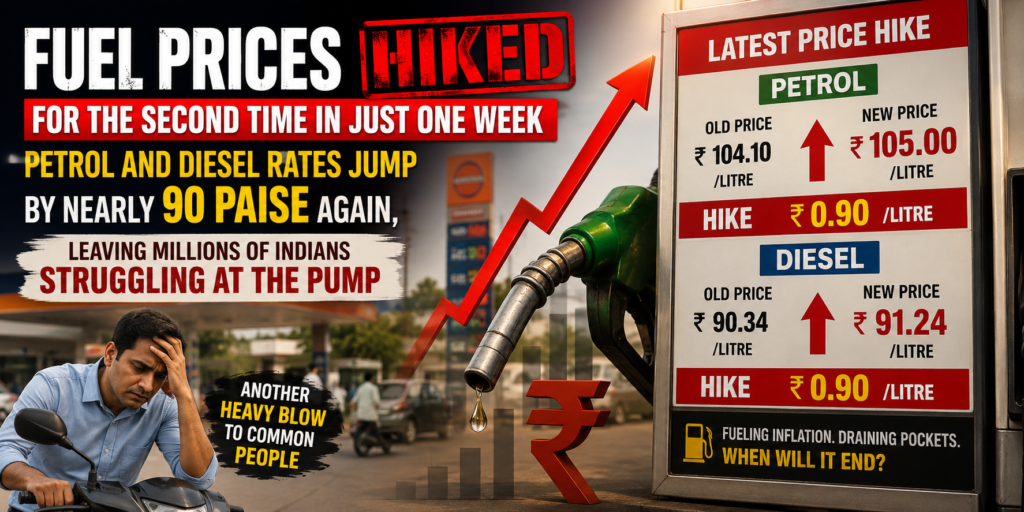
If you thought last week’s fuel price shock was the end of it — think again. India has just witnessed another round of petrol and diesel price hikes, and this time it has hit consumers twice within the same seven-day window. Oil marketing companies have increased petrol prices by around 86 paise per litre and diesel by approximately 83 to 94 paise per litre across major cities. For millions of everyday Indians who rely on two-wheelers, autos, trucks, and cabs to get through their day, this is not just a number — it’s a direct blow to the monthly budget.
What Exactly Happened This Time?
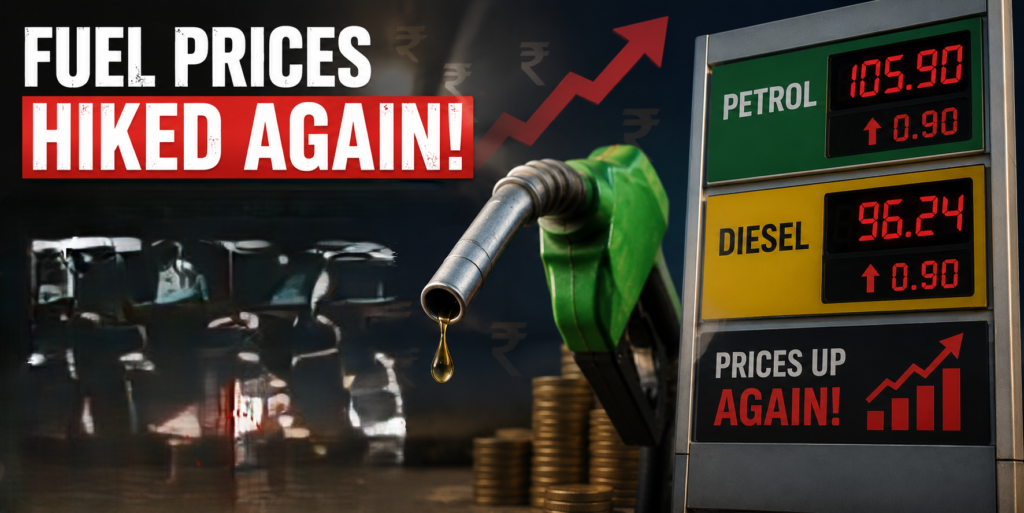
Just days after state-run oil marketing companies (OMCs) rolled out a massive ₹3-per-litre increase — the first big revision in nearly four years — fuel prices have gone up again. This second hike within a week has left consumers stunned and frustrated, especially those who had already adjusted to the first jolt.
In Delhi, petrol had already climbed to ₹97.77 per litre after the first round of hikes, while diesel touched ₹90.67. Now, with the fresh addition of around 86 to 94 paise, prices across the country have pushed even higher. In Kolkata and Mumbai, diesel prices rose by 94 paise each, reaching ₹96.07 and ₹94.08 per litre, respectively. Chennai saw diesel go up by 86 paise to ₹96.11 per litre.
Meanwhile, several cities — especially in southern India — are already staring at petrol prices beyond the ₹100 mark. Hyderabad and Thiruvananthapuram are reporting petrol rates upwards of ₹110 per litre. Mumbai, Kolkata, and Bengaluru have also crossed the ₹100-per-litre threshold for petrol, making daily commuting significantly more expensiv
Why Are Fuel Prices Increasing So Rapidly?
The core reason is not hard to find — it lies in what’s happening thousands of kilometres away from India, in the turbulent waters of West Asia.
Escalating geopolitical tensions in the Middle East, particularly around the Strait of Hormuz — one of the world’s most critical oil transit routes — have caused massive disruptions in the global energy supply chain. A significant chunk of the world’s crude oil passes through this narrow strait, and any instability there sends crude prices spiralling upward in global markets.
Brent crude, which was hovering around $69 per barrel in February, has surged to well above $107 per barrel in recent weeks, at one point crossing $120. Since India imports nearly 90 per cent of its crude oil requirements, this international volatility hits domestic fuel prices very directly.
Oil marketing companies like Indian Oil, BPCL, and HPCL had been absorbing these losses for a while, but with mounting financial pressure — reportedly running into tens of thousands of crores — they had no option but to pass the cost on to consumers.
Union Petroleum Minister Hardeep Singh Puri had already flagged this issue, warning that if retail prices are not revised periodically, oil marketing companies will face unsustainable losses, which could ultimately affect the fuel supply itself.
City-Wise Fuel Prices After the Latest Hike
Here’s a quick look at how petrol and diesel are now priced across major Indian cities:
Petrol Prices:
- Delhi: ₹97.77+ per litre
- Mumbai: ₹106.68+ per litre
- Bengaluru: ₹106.21+ per litre
- Kolkata: ₹108.70+ per litre
- Hyderabad: ₹110.89+ per litre
- Thiruvananthapuram: ₹110.58+ per litre
- Lucknow: ₹97.55+ per litre
- Chandigarh: Among the cheaper cities in the north
Diesel Prices:
- Delhi: ₹90.67+ per litre
- Kolkata: ₹96.07 per litre
- Mumbai: ₹94.08 per litre
- Chennai: ₹96.11 per litre
- Hyderabad: ₹98.96 per litre
- Thiruvananthapuram: Close to ₹100 per litre
- Chandigarh: ₹85.25 per litre (one of the cheapest diesel rates in the country)
- Ahmedabad: ₹87–₹89 per litre
Northern cities, particularly in Uttar Pradesh and Punjab, continue to enjoy relatively lower fuel prices compared to their southern counterparts, primarily due to differences in state-level Value Added Tax (VAT).
How Does This Affect the Common Indian?
The ripple effect of fuel price hikes doesn’t stop at the petrol pump. When diesel gets more expensive, freight costs go up. When freight costs go up, vegetables, grocery items, medicines, and almost everything else that’s transported across the country becomes pricier. This is especially hard for middle-class and lower-income households who are already dealing with inflationary pressure on food and essentials.
Truck operators and logistics companies are already reporting higher operational costs. Food delivery platforms, taxi aggregators, and small transport businesses — many of whom haven’t fully recovered from pandemic-era losses — are now grappling with yet another challenge.
Even CNG and PNG prices, which many had switched to as a more affordable alternative, have seen upward revisions in several cities over the past few days. The net result is that there’s almost no fuel category left that is shielded from the current wave of price increases.
What the Government Is Saying
The Centre has tried to reassure citizens that there is no fuel shortage in the country and that adequate reserves are in place. Officials have maintained that the price revisions are unavoidable given the pace of global crude price movements and the need to protect the financial health of oil marketing companies.
The government’s position is essentially this — India is not a crude oil producer at the scale it needs, and with 90 per cent of requirements coming from imports, global price movements will always have a direct bearing on what consumers pay at the pump.
Opposition Fires Back
Not surprisingly, the back-to-back price hikes have given the political opposition plenty of ammunition. Opposition parties have sharply criticised the government, accusing it of shifting the entire burden of global market volatility onto the shoulders of ordinary citizens. They’ve demanded immediate relief, including a reduction in central excise duty on fuel, which remains one of the highest in the world as a proportion of fuel pricing.
Excise duty currently adds over ₹21 per litre to the price of petrol, and VAT varies significantly by state. Critics argue that even a partial rollback in these taxes could bring significant relief without affecting supply or viability.
Will Fuel Prices Come Down Anytime Soon?
That’s the question on everyone’s mind — and honestly, there’s no easy answer right now.
It largely depends on how quickly the geopolitical situation in West Asia stabilises and whether crude oil prices begin to retrace from their current elevated levels. Market analysts suggest that as long as tensions around the Strait of Hormuz remain high, global crude prices are unlikely to soften significantly.
Unless the government steps in with a tax-cut relief package or international crude prices fall sharply, consumers may need to brace themselves for fuel rates staying high — or possibly edging even higher in the short term.
Final Word
Two petrol fuel price hikes in a single week is not something India sees often. The last major revision before this one had come nearly four years ago, which is why this rapid back-to-back increase feels especially jarring. The reasons are real — a global energy crisis, supply route disruptions, and international crude prices that have more than doubled in a short span.
But for the auto driver starting his morning shift, the truck driver hauling goods across states, or the homemaker calculating her grocery budget — what matters most is not the geopolitics but the pinch they feel every single day. And right now, that pinch is getting harder to ignore.
Stay updated with your city’s daily fuel prices through the IOCL, BPCL, and HPCL official apps, which revise rates every morning at 6 AM.
10 Unique FAQs — Fuel Prices Hiked Second Time in a Week: Petrol & Diesel Up by 90 Paise
1. Is it legal for oil companies to hike fuel prices twice in one week?
Absolutely yes — and it is completely within the framework set by the Indian government. Since 2017, India follows a dynamic fuel pricing system, which means oil marketing companies are legally allowed to revise petrol and diesel prices every single day if needed, based on international crude oil rates and the rupee-dollar exchange rate. There is no law that restricts how many times prices can change in a week. The government deregulated fuel pricing precisely to avoid the kind of long gaps and sudden massive shocks that happened in the past.
Q2. Why do petrol prices differ so much between Delhi and Mumbai when it is the same fuel?
This is one of the most common confusions among Indian consumers. The base price of fuel is the same across India, but what you actually pay at the pump includes state-level Value Added Tax (VAT), local body taxes, and freight charges — all of which vary from state to state and even city to city. Maharashtra levies a significantly higher VAT on fuel than Delhi, which is why Mumbai always ends up more expensive. So when you are paying more in one city, you are essentially paying more in state tax, not for better fuel.
Q3. Do petrol pumps make more money when fuel prices go up?
Not really — and this often surprises people. Petrol pump dealers earn a fixed commission per litre sold, which is set by oil marketing companies and does not automatically increase with every price hike. In fact, when prices rise sharply, consumer demand tends to dip slightly, meaning dealers may sell fewer litres overall. The real financial beneficiaries of higher fuel prices are the central and state governments through excise duty and VAT collections, which rise proportionally with the retail price.
Q4. If crude oil prices fall tomorrow, will petrol and diesel prices drop immediately in India?
In theory, yes — India’s dynamic pricing system is designed to work both ways. But in practice, there is often a delay or asymmetry. Prices tend to rise faster when crude goes up but come down much more slowly when crude falls. This pattern has been widely criticised by consumers and opposition parties alike. The government and oil marketing companies usually cite operational costs, currency fluctuations, and the need to recover previous losses as reasons for the slower downward movement.
Q5. Can I do anything as a consumer to avoid the impact of rising fuel prices?
You have more options than you think. Carpooling, switching to a CNG or electric vehicle, using public transport on alternate days, maintaining proper tyre pressure (which improves fuel efficiency by up to 3%), and avoiding unnecessary idling are all practical steps. If you run a business that depends on diesel logistics, negotiating long-term freight contracts before prices rise further can offer some protection.
Q6. Why does India not produce enough crude oil to avoid depending on global prices?
India does have domestic crude oil production, primarily from fields in Rajasthan, Gujarat, and offshore sites in the Arabian Sea operated by ONGC and Oil India. However, domestic production meets only about 10 to 12 per cent of the country’s total crude oil needs. The geology of India does not have the kind of large, easily accessible oil reserves found in the Middle East or Russia. Increasing domestic production takes decades of exploration and massive capital investment, making import dependence a structural reality for the foreseeable future.
Q7. What happens to airlines and aviation when diesel and petrol prices rise — does it affect flight tickets too?
Airlines do not use petrol or diesel — they run on Aviation Turbine Fuel (ATF), which is a separate fuel category. However, ATF prices move in the same direction as crude oil prices, so when global crude surges, ATF becomes more expensive too. Airlines typically respond by adding a fuel surcharge to ticket prices or gradually raising base fares, especially on domestic routes. So yes — if you are planning to fly in the coming weeks, there is a real possibility that airfares will edge higher as a direct consequence of the ongoing global crude oil crisis.
Q8. Is the current fuel price hike worse than what happened during COVID-19 or the 2008 oil crisis?
Each fuel crisis in India has had its own character. The 2008 global oil crisis saw Brent crude touch $147 per barrel, which was extreme but short-lived. During COVID-19, crude oil prices actually collapsed to historic lows, yet Indian retail fuel prices did not fall proportionately — the government quietly raised excise duty and pocketed the difference. The current situation is different because it combines a rapid crude price surge with back-to-back retail hikes hitting consumers directly, without any buffer from tax reductions. In terms of visible consumer impact in a short period, this week ranks among the more painful episodes in recent memory.
Q9. Does paying more for fuel mean the quality of petrol or diesel has improved?
No — not at all. The quality, grade, and composition of petrol and diesel at standard pumps remain exactly the same regardless of the price revision. What changes is purely the cost, driven by input and tax components. If you want higher-quality fuel, you would need to specifically ask for premium variants like Speed, Power, or XP95 petrol, which are priced higher even on normal days. Standard fuel quality is regulated by Bureau of Indian Standards (BIS) and does not change with market price fluctuations.
Q10. How does a fuel price hike in India affect a farmer in a village who does not own a vehicle?
This is perhaps the most overlooked impact of fuel price hikes. A farmer who does not own a vehicle is still deeply affected in at least three ways. First, the diesel that runs the irrigation pump on the farm becomes more expensive, raising cultivation costs directly. Second, the cost of transporting crops from the village to the mandi goes up, which often means the middleman pays the farmer less to protect his own margins. Third, the prices

Ghananand is the Founder & Chief Editor of NewzStrome. Hailing from Prayagraj, Uttar Pradesh, he brings 1.5 years of hands-on experience in journalism and digital media. He delivers sharp, unbiased, and timely news from India and across the globe. Passionate about investigative reporting, technology, politics, and lifestyle, Ghananand is committed to bringing readers nothing but the truth