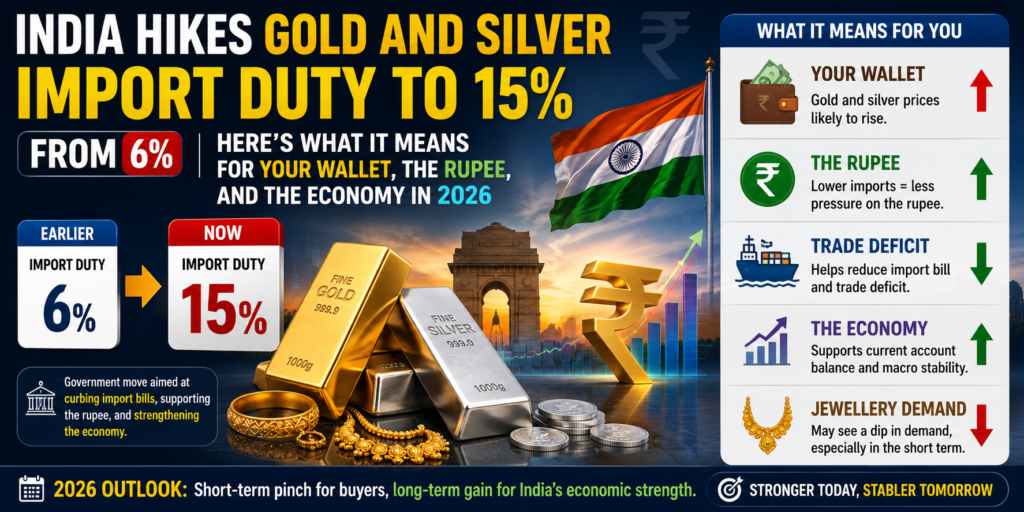
If you’ve been planning to buy gold jewellery, coins, or silver artefacts anytime soon, here’s news that’s going to make you pause. The Indian government has quietly but firmly raised the import duty on gold and silver to 15% — more than doubling the previous rate of 6%. This isn’t a minor policy tweak. It’s a bold economic signal, and it affects everyone from the everyday jewellery buyer in Kanpur to the large bullion traders in Mumbai.
What Exactly Changed?
The government has issued two official orders that raise the effective import tariff on gold and silver to around 15%. The structure works like this: a basic customs duty of 10% is now imposed, alongside a 5% Agriculture Infrastructure and Development Levy (AIDL). Together, these take the total import cost to approximately 15% — up from the earlier 6%.
That’s more than a 2.5x jump in the duty rate, and it didn’t happen without reason.
Why Did the Government Do This?
To understand the “why,” you need to look at what’s been happening to India’s economy in recent months.
India has always had an insatiable appetite for gold. We are among the world’s largest consumers of bullion, and a significant portion of that demand is met through imports. When gold and silver imports surge, they drive up the country’s import bill, widen the trade deficit, and put enormous pressure on the Indian rupee.
In the current global environment — marked by ongoing geopolitical tensions, particularly fallout from the Middle East conflict — capital has been flowing out of emerging markets like India. The rupee has been facing pressure. More gold imports mean more dollars going out of the country to pay for them, which weakens the currency further.
The government’s move to raise import duties is designed to do two things at once: make gold imports more expensive and therefore less attractive, and take some of the pressure off the rupee by reducing the outflow of foreign exchange.
Think of it this way — every extra tonne of gold that enters India requires precious foreign exchange reserves to pay for it. In times when the rupee is already under stress, that’s a problem the government simply cannot afford to ignore.
What Happens to Gold and Silver Prices Now?
Here’s the part most people are asking about. When import duties go up, the landed cost of gold rises for importers. And when their cost rises, they pass it on. So yes — gold and silver prices in India are going to go up.
Historically, every time the government has raised import duty on gold, domestic gold prices have responded sharply. After a similar move in the past, gold prices on the MCX crossed the ₹52,000 mark per 10 grams within a single trading session. This time, the jump in duty is even sharper given the starting base of just 6%.
For silver, the same logic applies. Silverware, industrial silver, and silver jewellery will all see price increases downstream.
What Does This Mean for Jewellery Buyers?
If you were waiting for the “right time” to buy gold jewellery, the situation just got more complicated. In the short term, prices are likely to spike. Retailers will recalibrate their inventory costs, and that will reflect at the counter.
However, from a longer-term perspective, if the rupee stabilises because of this policy measure, gold prices in rupee terms could actually moderate. A stronger rupee against the dollar would mean cheaper imports even with higher duties. So the equation isn’t entirely one-sided.
For now though, if you were sitting on the fence about a purchase, expect to pay more.
What About the Jewellery Industry?
Industry stakeholders are unlikely to be thrilled about this move. The gems and jewellery sector employs millions of people across India, and higher gold prices historically soften consumer demand. When gold becomes expensive, buyers delay purchases, reduce the weight of jewellery they buy, or shift to alternative metals.
There is also the concern about smuggling. When legal import becomes costly, illegal channels become more attractive. This has been a recurring issue in India’s gold trade story — every significant duty hike has, in the past, been accompanied by a rise in gold being smuggled into the country. The government and agencies like the Directorate of Revenue Intelligence will need to stay alert.
The Bigger Economic Picture
This move needs to be seen in the context of India’s current account deficit (CAD) management. A widening CAD is one of the early warning signs of macroeconomic stress. When imports far outpace exports, it creates an imbalance that weakens the currency and drains foreign exchange reserves.
Gold imports are one of the most controllable parts of India’s import bill. Unlike crude oil (which we need regardless of the price), gold imports can be reduced through price signals. Higher duties are that signal.
The Reserve Bank of India has also been active in managing the rupee through currency market interventions. The duty hike works alongside those efforts — one is a fiscal tool, the other a monetary one. Together, they create a more coordinated defence of the currency.
Should You Be Worried?
Not exactly worried, but definitely informed. This policy move reflects the government’s proactive approach to economic management. It may cause short-term pain in the form of higher gold prices, but the intent is to prevent a larger crisis — a sharply depreciating rupee, a bulging trade deficit, and drained foreign reserves.
For consumers, this is a reminder that gold, as much as we love it culturally and emotionally, remains deeply tied to global economics. Its price in your local jewellery store is shaped by decisions made in South Block, the RBI headquarters, and even in the corridors of geopolitical tension thousands of kilometres away.
The Bottom Line
India’s decision to more than double the import duty on gold and silver — from 6% to 15% — is a significant and deliberate economic intervention. It is aimed at curbing runaway bullion imports, defending the rupee, and keeping the current account deficit in check during a challenging global environment.
The short-term consequence is higher gold and silver prices. The longer-term hope is a more stable rupee and a healthier trade balance. Whether this gamble pays off will depend on how global markets move and how India’s broader economic indicators respond in the coming months.
For now, keep a close eye on gold prices — and maybe hold off on that big jewellery purchase for just a little while.
FAQ 1
Q: Why has India raised the import duty on gold and silver to 15%?
A: The government raised the import duty to curb the rising volume of gold and silver imports, reduce pressure on the current account deficit, and defend the Indian rupee against further depreciation, especially amid ongoing global geopolitical tensions.
FAQ 2
Q: What was the import duty on gold and silver before this hike?
A: Before this change, the effective import duty on gold and silver was 6%. The government has now more than doubled it to approximately 15%.
FAQ 3
Q: How is the 15% import duty on gold structured?
A: The 15% duty is made up of two components — a 10% basic customs duty and a 5% Agriculture Infrastructure and Development Levy (AIDL), both applied on gold and silver imports entering India.
FAQ 4
Q: Will gold prices in India increase because of this duty hike?
A: Yes, in the short term, gold prices in India are expected to rise. When import duties go up, the landed cost for importers increases and that higher cost gets passed on to retailers and ultimately to consumers.
FAQ 5
Q: How does rising gold import duty help the Indian rupee?
A: Higher duties make gold imports more expensive, which discourages bulk purchases. Fewer imports mean less foreign exchange (dollars) flowing out of India, which reduces pressure on the rupee and helps stabilise it.
FAQ 6
Q: Will silver prices also go up after this duty change?
A: Yes. Since both gold and silver are covered under the new import duty orders, silver prices in India — including silverware, industrial silver, and silver jewellery — are also expected to rise in line with the higher import cost.
FAQ 7
Q: How does this gold import duty hike affect the jewellery industry?
A: Higher gold and silver prices typically soften consumer demand, which can impact jewellery sales. The gems and jewellery sector, which employs millions of workers across India, may see buyers delay purchases or opt for lighter-weight pieces as a result.
FAQ 8
Q: Can higher import duty lead to more gold smuggling in India?
A: This is a genuine concern. Historically, when legal import becomes significantly more expensive, illegal channels become more attractive to traders looking to avoid duties. Enforcement agencies like the Directorate of Revenue Intelligence will need to remain vigilant.
FAQ 9
Q: Is this the first time India has raised gold import duty so sharply?
A: No. India has adjusted gold import duties multiple times in the past based on economic conditions. A notable example was in 2022 when the government raised gold customs duty sharply to address a widening trade deficit and a falling rupee. The current hike follows a similar pattern of using fiscal tools to manage economic pressure.
FAQ 10
Q: Is this the first time India has raised gold import duty so sharply?
A: No. India has adjusted gold import duties multiple times in the past based on economic conditions. A notable example was in 2022 when the government raised gold customs duty sharply to address a widening trade deficit and a falling rupee. The current hike follows a similar pattern of using fiscal tools to manage economic pressure.

Ghananand is the Founder & Chief Editor of NewzStrome. Hailing from Prayagraj, Uttar Pradesh, he brings 1.5 years of hands-on experience in journalism and digital media. He delivers sharp, unbiased, and timely news from India and across the globe. Passionate about investigative reporting, technology, politics, and lifestyle, Ghananand is committed to bringing readers nothing but the truth