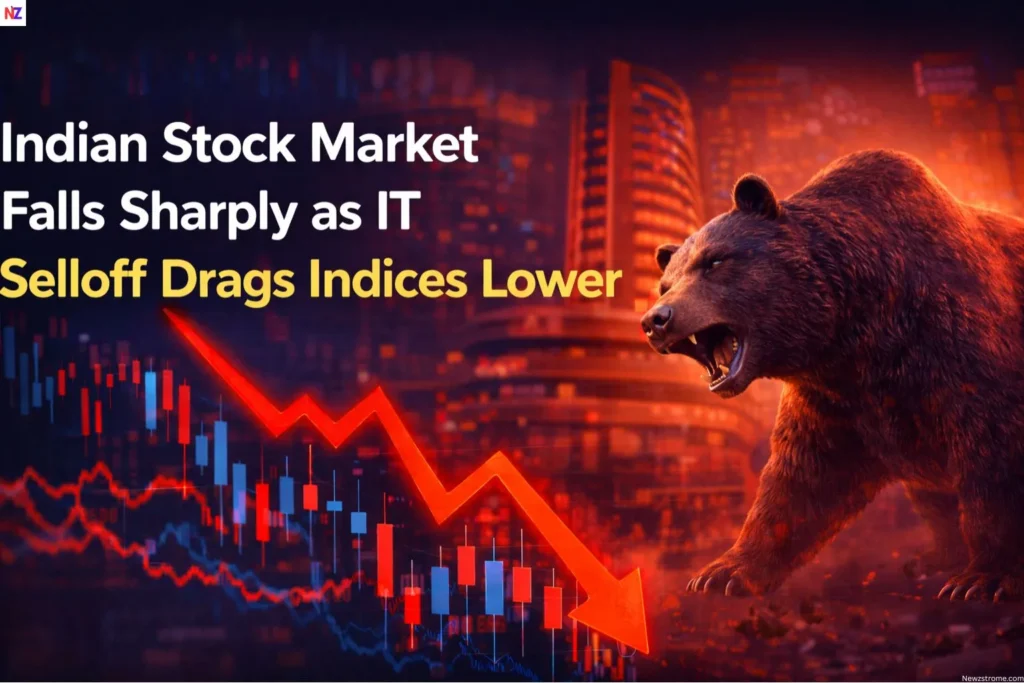
On February 13, 2026, Indian equity markets experienced strong selling pressure, with the major benchmark indices, the BSE Sensex and Nifty 50, dropping significantly during the day’s trading.
The decline was driven by weak global market performance, a sharp fall in IT stocks, and cautious investor mood, resulting in losses across multiple sectors.
By the afternoon, the Sensex fell by over 900 points, while the Nifty 50 dropped below the important 25,550 level.
This marked the second straight session of losses, indicating rising unease among investors.
What Caused Today’s Market Decline?
1.
IT Stocks Lead the Decline
Technology stocks were the main factor behind the market drop.
There is growing concern that artificial intelligence could disrupt traditional IT business models, causing uncertainty about future earnings. This prompted investors to sell aggressively in the sector.
2.
Weak Global Market Sentiment
Global stock markets also performed poorly, influencing domestic investor confidence.
Futures for the S&P 500 remained flat, while Asian markets declined. Japan’s Topix dropped 1.1%, and Hong Kong’s Hang Seng Index fell by 1%. The Shanghai Composite Index also saw a slight decline, showing cautious investor behavior. In contrast, European markets showed slight gains in futures.
3.
Strong Dollar and Weak Rupee
Currency movements added to the pressure.
A stronger US dollar and a weaker Indian rupee raised fears of capital outflows and higher import costs, which hurt market sentiment.
4.
Weak Technical Indicators
Technical charts showed signs of bearish momentum, pushing short-term traders and institutional investors to sell more.
The failure to hold key support levels made the decline worse.
5.
Geopolitical Uncertainties
Ongoing global tensions have caused uncertainty, making investors favor safer assets over equities.
Sectoral Performance: Broad-Based Selling Observed
Most sectoral indices declined, showing broad-based weakness.
Real estate, metals, and media stocks fell sharply, while defensive sectors remained relatively stable but could not offset overall losses.
Among the worst performers were Muthoot Finance Ltd., which fell over 11%, and Adani Power Ltd. and Hindalco Industries Ltd., which also declined due to selling pressure in commodity and infrastructure-linked stocks.
Stocks That Rose Amid the Selloff
Despite the overall decline, some stocks performed well.
GE Power India Ltd. rose nearly 20%, becoming one of the top gainers. Engineers India Ltd. also showed strong gains as positive sentiment towards infrastructure-linked stocks improved.
In the textile and industrial sectors, Linde India Ltd. saw notable gains as demand in the industrial gas segment remained steady.
Corporate and Institutional Developments
Info Edge (India) Ltd., the parent company of Naukri.com, reported a 12% year-on-year increase in net profit for the third quarter, driven by strong revenue.
The Reserve Bank of India and ICICI Prudential Asset Management Company acquired Karur Vysya Bank Ltd., indicating continued interest in the banking sector despite the broader market dip.
Commodities and Crypto Market Overview
Gold prices recovered after recent declines, as investors awaited key US inflation data to gauge interest rate trends.
Silver also bounced back but remained on track for weekly losses.
In the cryptocurrency market, Bitcoin stabilized near $66,000 but remained under pressure due to the overall risk-averse sentiment.
Market Outlook
Experts expect continued volatility in the near term, due to global uncertainties, currency movements, and concerns over IT earnings.
Investors are expected to closely watch inflation data, global economic signals, and corporate results for direction.
While short-term fluctuations are likely, long-term investors are advised to focus on strong fundamentals and diversified portfolios to manage market uncertainties effectively.
Indian markets remain sensitive to global events and sector-specific factors.
The upcoming sessions will be crucial in determining whether markets stabilize or continue their downward trend.

Ghananand is the Founder & Chief Editor of NewzStrome. Hailing from Prayagraj, Uttar Pradesh, he brings 1.5 years of hands-on experience in journalism and digital media. He delivers sharp, unbiased, and timely news from India and across the globe. Passionate about investigative reporting, technology, politics, and lifestyle, Ghananand is committed to bringing readers nothing but the truth