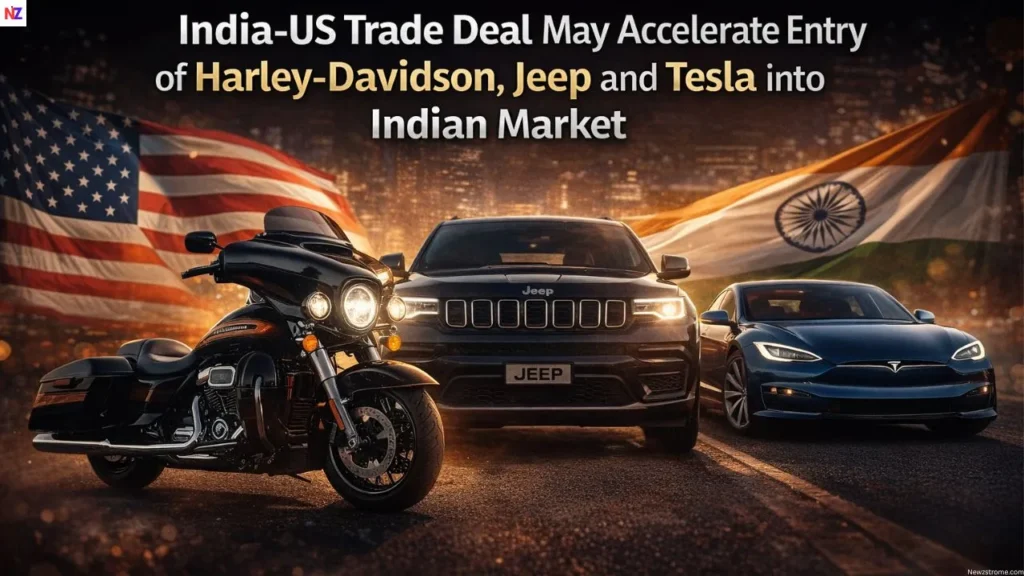
A new trade agreement between India and the United States is expected to create significant opportunities for American automobile manufacturers, including Harley-Davidson, Jeep, and Tesla. The agreement focuses on reducing import duties on specific vehicle categories, aiming to strengthen trade relations while ensuring minimal impact on domestic ensuring minimal impact on domestic manufacturers.
Harley-Davidson Gets Major Duty Relief

One of the biggest beneficiaries of the new trade framework is expected to be Harley-Davidson. Under the agreement, select Harley-Davidson motorcycles in the 800cc to 1,600cc engine segment are likely to receive zero import duty once the trade framework is fully implemented.
This concession marks a major development, as previous US administrations were unable to secure such duty reductions. The decision is expected to make Harley-Davidson motorcycles more competitively priced in India, potentially boosting sales and expanding the brand’s market presence.
Officials have clarified that the duty relaxation currently applies specifically to Harley-Davidson and not to other motorcycle manufacturers.
Jeep May Expand Premium SUV Portfolio in India
The trade deal also includes reduced import duties on high-capacity vehicles, which is expected to benefit Jeep, part of the Stellantis automotive group. The agreement proposes reducing duties on a fixed number of vehicles with engine capacities above 3,000cc from the current 110 percent to 50 percent, with a long-term plan to gradually reduce duties to zero over the next decade.
This reduction could allow Jeep to introduce premium global models into India through the import route. Stellantis India Managing Director and CEO Shailesh Hazela indicated that the company is evaluating opportunities to expand Jeep’s premium SUV portfolio in the Indian market.
The company is also exploring export opportunities from India, as reduced trade barriers may strengthen manufacturing competitiveness and help integrate Indian operations more effectively into global supply chains.
Tesla Likely to Gain from EV Duty Reductions
Electric vehicle giant Tesla is also expected to benefit from the trade deal, although detailed guidelines regarding EV imports are still under development. The reduction in tariffs on high-value imported vehicles may help Tesla introduce select models into the Indian market more competitively.
India has been a strategic target for Tesla for several years, and the easing of import duties could support the company’s entry plans while encouraging advanced electric vehicle technology adoption in the country.
Limited Impact on Domestic Automobile Industry
Government officials and industry experts have emphasised that the trade concessions are designed carefully to avoid harming Indian automobile manufacturers. Domestic carmakers currently have limited presence in the high-capacity engine segment, particularly in vehicles above 3,000cc.
Industry insiders suggest that the number of vehicles falling into this category remains relatively low, even among global luxury brands such as Mercedes-Benz, BMW, Volkswagen, and Skoda. As a result, the duty reductions are unlikely to significantly affect domestic production or sales volumes.
Trade Deal to Strengthen Import and Export Opportunities
Beyond vehicle imports, the agreement is expected to enhance export potential for Indian automobile manufacturing. Reduced trade barriers may encourage global manufacturers to use India as a production hub, boosting investment, employment opportunities, and technology transfer within the industry.
The deal also reflects India’s broader strategy to balance domestic manufacturing growth with increased global trade participation, ensuring that international partnerships contribute to long-term economic developmen
What This Means for Indian Consumers
For Indian buyers, the duty reductions could eventually lead to greater access to premium motorcycles, luxury SUVs, and advanced electric vehicles. While immediate price drops may depend on final policy details and import volumes, the agreement signals increased competition and expanded product choices in the premium automotive segment.
A Strategic Shift in India-US Automotive Trade
The trade deal highlights a strategic shift in India-US economic cooperation, particularly in the automobile sector. By offering targeted duty concessions while safeguarding domestic manufacturing, the agreement aims to create a balanced trade environment.
If implemented successfully, the policy could accelerate the expansion of premium American automotive brands in India while strengthening India’s position in global automotive supply chains.

Ghananand is the Founder & Chief Editor of NewzStrome. Hailing from Prayagraj, Uttar Pradesh, he brings 1.5 years of hands-on experience in journalism and digital media. He delivers sharp, unbiased, and timely news from India and across the globe. Passionate about investigative reporting, technology, politics, and lifestyle, Ghananand is committed to bringing readers nothing but the truth