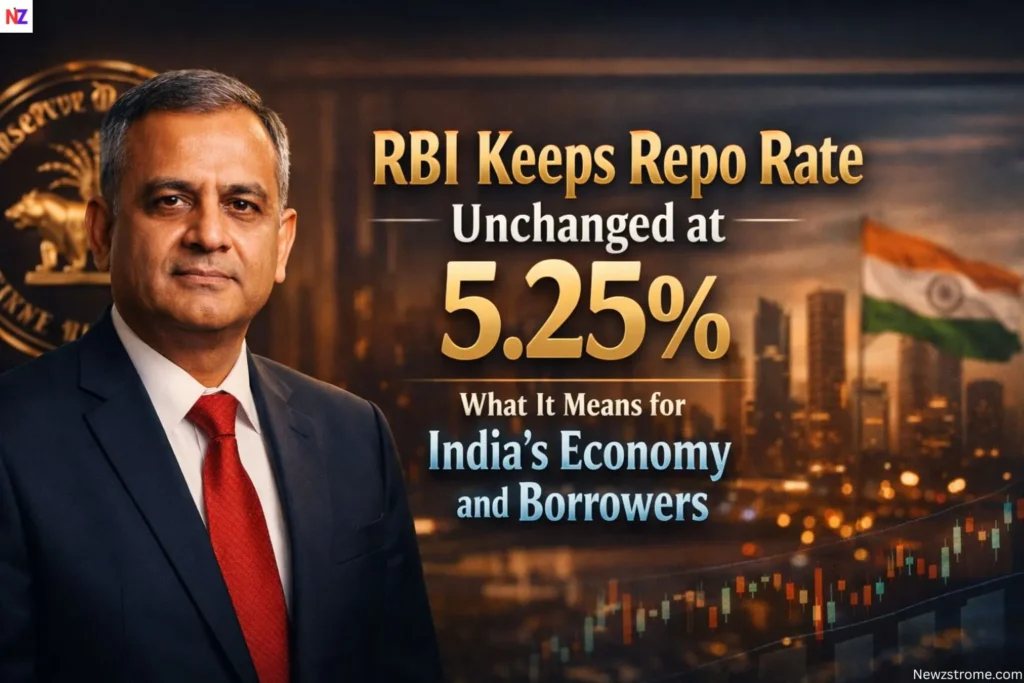
The Reserve Bank of India (RBI) has decided to keep the repo rate unchanged at 5.25%, signalling a balanced approach toward inflation control and economic growth. The announcement was made by RBI Governor Sanjay Malhotra following the Monetary Policy Committee (MPC) meeting held on February 6, 2026. The decision was taken unanimously, reflecting confidence in the country’s current economic position and outlook.
Why RBI Held the Repo Rate Steady
It directly impacts loan and deposit interest rates across the banking system. By keeping the repo rate unchanged, the RBI is aiming to maintain stability in borrowing costs while closely monitoring inflation and growth trends.
Governor Malhotra stated that domestic inflation and economic growth outlook remain positive. He also highlighted that India’s economy continues to show resilience despite global uncertainties and external economic pressures. The MPC maintained a neutral stance, meaning future policy decisions will depend on how economic conditions evolve in the coming months.
Growth Outlook Shows Positive Signs
The RBI has revised its real GDP growth projections upward for the first two quarters of the financial year 2026-27. This indicates stronger economic momentum driven by domestic consumption, infrastructure development, and investment activity. The Governor also mentioned that recently completed international trade agreements are expected to support India’s economic performance and improve export opportunities.Despite rising global challenges, India’s strong domestic demand and stable financial sector have helped sustain growth. The central bank remains optimistic about maintaining a healthy balance between inflation control and economic expansion.
Inflation Projection Remains Under Control
Controlled inflation provides relief to consumers and helps maintain purchasing power. Stable inflation levels also allow the central bank to avoid aggressive interest rate changes, which could otherwise affect borrowing and investment patterns.
Maintaining inflation within a comfortable range remains a key priority for the RBI, as price stability supports long-term economic growth and financial stability.
Liquidity and Forex Reserves Strengthen Financial Stability
The central bank confirmed that system liquidity remained comfortable, averaging around ₹75,000 crore daily. The RBI had taken several measures between December and January to ensure adequate liquidity in the financial system, supporting lending and economic activity.
Additionally, India’s foreign exchange reserves were reported at $723.8 billion by the end of January, reflecting strong external financial stability. Healthy forex reserves help manage currency volatility and strengthen investor confidence in the Indian economy.
New Policy Proposals Announced by RBI
Along with the repo rate decision, the RBI introduced several proposals aimed at improving financial system efficiency. The central bank plans to launch a unified portal to enhance Lead Bank data management. This move is expected to improve coordination among banks and strengthen financial inclusion efforts.
The RBI also proposed easing branch opening norms for Non-Banking Financial Companies (NBFCs). This step could improve credit access, especially in underserved and semi-urban areas. Furthermore, banks may now be allowed to lend to Real Estate Investment Trusts (REITs) under specific safeguards, potentially supporting infrastructure and real estate development.
What It Means for Borrowers and Investors
Since the repo rate remains unchanged, loan interest rates for home loans, vehicle loans, and business loans are likely to remain stable in the short term. Borrowers may not see immediate changes in EMIs, which provides financial predictability for households and businesses.
For investors, stable interest rates typically support equity market sentiment while maintaining balance in fixed-income investment returns. The RBI’s neutral policy stance indicates that future rate changes will depend on inflation trends, global economic conditions, and domestic growth performance.
Economic Outlook Ahead
The RBI’s decision reflects cautious optimism about India’s economic trajectory. With steady growth projections, controlled inflation, strong liquidity, and robust forex reserves, the central bank appears focused on maintaining macroeconomic stability. The coming months will be crucial as policymakers continue to monitor global risks, domestic demand, and financial market trends to shape future monetary policy decisions.
Financial Outlook: How the 5.25% Repo Rate Impacts Your Wallet
The RBI’s decision to hold the repo rate steady at 5.25% brings a sigh of relief for existing home and auto loan borrowers, as EMIs will not see an immediate hike. This ‘status quo’ approach indicates that the central bank is carefully balancing inflation control with economic growth. For investors, this means Fixed Deposit (FD) rates have likely peaked and might start softening in the coming quarters. At Newzstrome, we suggest that conservative investors lock in long-term FDs now, while stock market participants should brace for sector-specific volatility rather than broad market rallies.
(Disclaimer: This is for educational purposes, not financial advice).

Ghananand is the Founder & Chief Editor of NewzStrome. Hailing from Prayagraj, Uttar Pradesh, he brings 1.5 years of hands-on experience in journalism and digital media. He delivers sharp, unbiased, and timely news from India and across the globe. Passionate about investigative reporting, technology, politics, and lifestyle, Ghananand is committed to bringing readers nothing but the truth