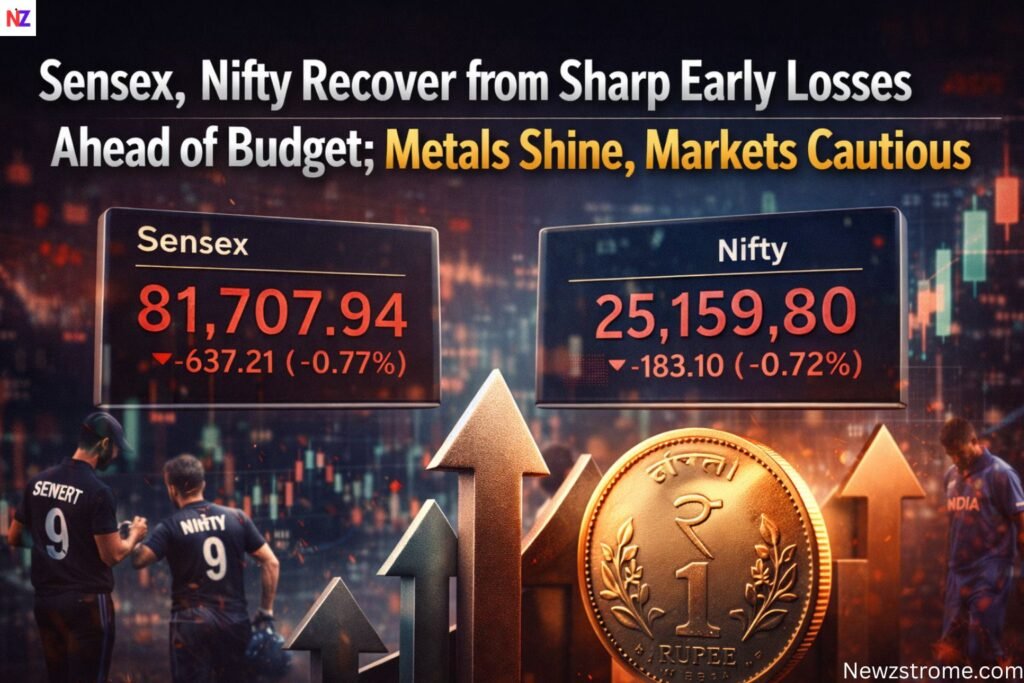
Indian equity markets staged a notable intraday recovery on Thursday after a weak opening, as investors remained cautious ahead of the Union Budget scheduled this weekend. A broad-based selloff in early trade dragged benchmarks sharply lower, but selective buying helped pare losses by midday.
The Sensex slipped as much as 637 points, or nearly 0.8%, to an intraday low of 81,707, while the Nifty 50 dropped 183 points to fall below the key 25,200 mark. However, both indices clawed back most of the losses as the session progressed, reflecting bargain hunting in select pockets of the market.
Risk-Off Mood Dominates Trading
Market sentiment remained defensive through the day, with sectoral trends pointing to a risk-off undertone. Consumption, technology and defensive stocks faced sustained pressure, while metals emerged as the standout performers, supported by optimism around global commodity prices and cyclical recovery themes.
Financial and energy stocks provided limited stability, preventing deeper losses, but the broader tone suggested a corrective phase rather than a decisive rebound. Market participants appeared unwilling to take aggressive positions ahead of the Budget, opting instead for selective stock-specific buying.
Metals Lead, Financials Hold Ground
Metal stocks surged on the back of strong global cues and record copper prices. Hindustan Copper rallied sharply, emerging among the top gainers, while Tata Steel, NMDC and Hindustan Zinc also traded higher. The rally underscored renewed interest in commodity-linked stocks amid expectations of sustained demand.
Financial stocks showed mixed performance. While select banking names managed modest gains, broader participation remained muted as investors assessed interest rate expectations and asset quality trends.
Energy stocks also edged higher, tracking gains in crude oil prices, which helped cushion broader market weakness.
Stock-Specific Action Drives Midday Trade
Stock-specific actions were the main driver of midday trading activity. Shares of KRM Ayurveda experienced a significant increase, while Rain Industries, ABB India, and GE Vernova T&D India also saw strong gains, fueled by positive earnings outlooks and corporate updates.
ABB India stood out after announcing a positive outlook for 2026 and introducing a $2 billion buyback plan, which boosted investor confidence in the company.
On the other hand, certain financial and consumer sector stocks, including Five-Star Business Finance, Thyrocare Technologies, and Vaibhav Global, faced selling pressure due to concerns about their valuations.
Earnings Season Keeps Investors Busy
The ongoing earnings season added to intraday volatility. Adani Power reported a year-on-year decline in both revenue and net profit for the December quarter, reflecting softer margins. Ajmera Realty also posted lower revenue and profit compared to the same period last year.
In contrast, Canara Bank delivered a strong set of numbers, reporting a 26% year-on-year jump in profit, supported by stable net interest income. The results provided some relief to banking stocks amid broader market uncertainty.
Global Markets Mixed
Global cues were mixed, offering little directional clarity. Asian markets traded with a cautious bias, with Japan’s Nikkei and Australia’s ASX slipping, while Hong Kong’s Hang Seng posted modest gains. US equity futures were largely flat, reflecting investor restraint ahead of key economic data and policy signals.
Currency markets also remained in focus, with the Indian rupee hitting record lows against the US dollar in early trade, adding to near-term concerns for import-heavy sectors.
What Lies Ahead
Market experts believe the recent recovery is largely driven by short-covering ahead of the Union Budget rather than a shift in underlying sentiment. Investors remain wary of carrying large positions into a major policy event, particularly amid global uncertainty and foreign investor outflows.
While expectations of growth-supportive announcements continue to provide hope, analysts caution that sustained upside will depend on clear policy signals, earnings momentum and global risk appetite.
For now, Indian equities appear set to remain range-bound, with volatility likely to persist as investors await Budget clarity and fresh global triggers.

Ghananand is the Founder & Chief Editor of NewzStrome. Hailing from Prayagraj, Uttar Pradesh, he brings 1.5 years of hands-on experience in journalism and digital media. He delivers sharp, unbiased, and timely news from India and across the globe. Passionate about investigative reporting, technology, politics, and lifestyle, Ghananand is committed to bringing readers nothing but the truth