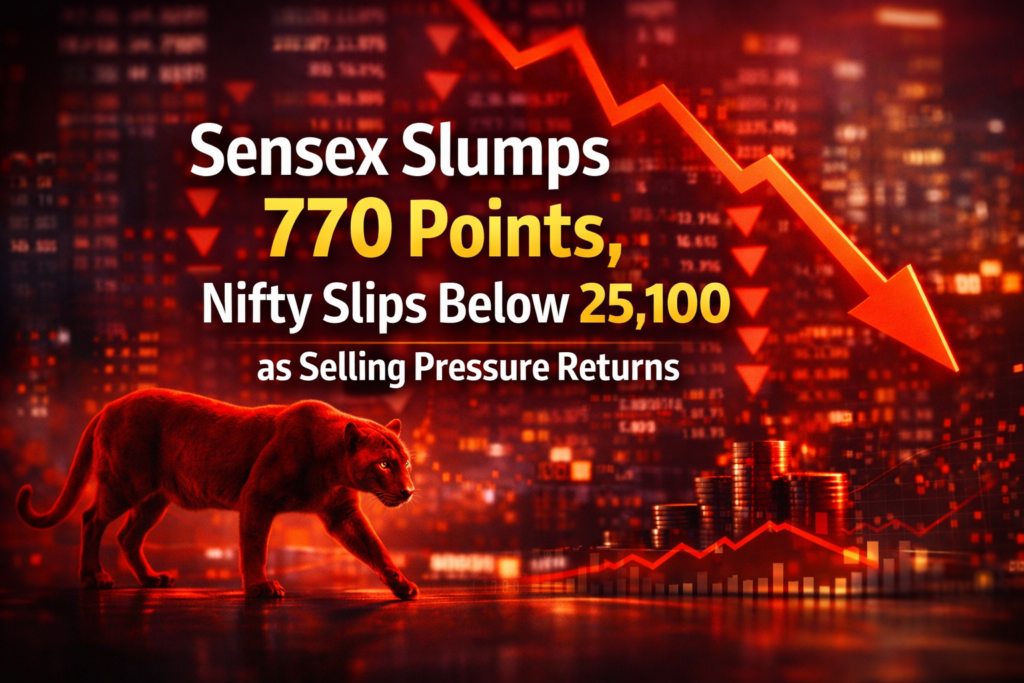
Indian equity markets ended sharply lower on Friday, January 23, as early optimism fizzled out amid sustained foreign selling and renewed risk aversion. Benchmark indices reversed gains from the opening session, highlighting the fragile nature of investor sentiment despite supportive cues from Asian markets and easing geopolitical concerns.
The BSE Sensex closed lower by 770 points, or nearly 1%, while the Nifty 50 slipped below the crucial 25,100 mark. The sharp reversal came just a day after markets snapped a short losing streak, underscoring the lack of sustained buying interest at higher levels
What triggered today’s market fall?
The selloff was primarily driven by persistent foreign institutional investor (FII) outflows, which continued to weigh heavily on domestic equities. Despite a stable start supported by positive global cues, selling pressure intensified through the session as investors turned cautious amid currency weakness and stock-specific concerns.
The Indian rupee hit a fresh all-time low, settling near 91.93 against the US dollar, adding to worries around imported inflation and capital outflows. The sharp depreciation further dampened sentiment across interest rate-sensitive and import-heavy sectors.
Adani stocks under pressure
Adani Group stocks were among the biggest laggards of the session, amplifying benchmark losses. Shares of Adani Ports & Special Economic Zone fell around 7%, while Adani Green Energy, Adani Enterprises and Adani Energy Solutions declined between 10% and 14%.
The selloff followed reports that a US regulator has sought to directly serve summons to key Adani Group executives in connection with an ongoing investigation. The news triggered heavy selling across group stocks, dragging broader indices lower.
Eternal, banks and other laggards
Shares of Eternal dropped nearly 6% after weak quarterly performance and cautious commentary, extending recent losses. Financial stocks also remained under pressure, with select private lenders and PSU banks seeing notable declines as rising bond yields and currency volatility weighed on outlook.
Among other prominent losers were InterGlobe Aviation, Axis Bank and Power Grid Corporation, all of which ended the session in the red.
Broader markets and sectoral performance
Broader markets underperformed the benchmarks, reflecting a clear risk-off mood. Midcap and smallcap stocks witnessed sharper cuts as investors trimmed exposure to higher-risk segments.
Sectorally, realty, power, capital goods and PSU banks were among the worst hit, while defensives such as FMCG and select IT stocks offered limited support. Market breadth remained weak, with declining stocks far outnumbering advances.
Key stock-specific updates
On the earnings front, JSW Steel reported a strong December-quarter performance, with consolidated profit surging over threefold to ₹2,410 crore, supported by higher sales and lower input costs. Despite the robust numbers, the stock failed to lift overall market sentiment.
Adani Power announced that it has raised ₹7,500 crore through non-convertible debentures from domestic institutions, while Bharat Petroleum Corporation said it will sign an oil purchase agreement with Brazil’s Petrobras for 12 million barrels of crude. These developments, however, did little to counter the broader selling pressure.
Meanwhile, crude oil prices rose over 2% on the MCX, tracking firm global cues and spot demand, adding another layer of uncertainty for equity investors.
What should investors watch next?
Market participants will closely track global cues, currency movement and FII flows in the coming sessions. With volatility elevated and macro headwinds persisting, experts advise a cautious approach in the near term.
While corrections are part of market cycles, sustained recovery will likely depend on stabilisation in the rupee, clarity on global interest rate trajectories and a slowdown in foreign selling. Until then, investors may prefer to focus on fundamentally strong stocks and maintain disciplined risk management strategies.

Ghananand is the Founder & Chief Editor of NewzStrome. Hailing from Prayagraj, Uttar Pradesh, he brings 1.5 years of hands-on experience in journalism and digital media. He delivers sharp, unbiased, and timely news from India and across the globe. Passionate about investigative reporting, technology, politics, and lifestyle, Ghananand is committed to bringing readers nothing but the truth