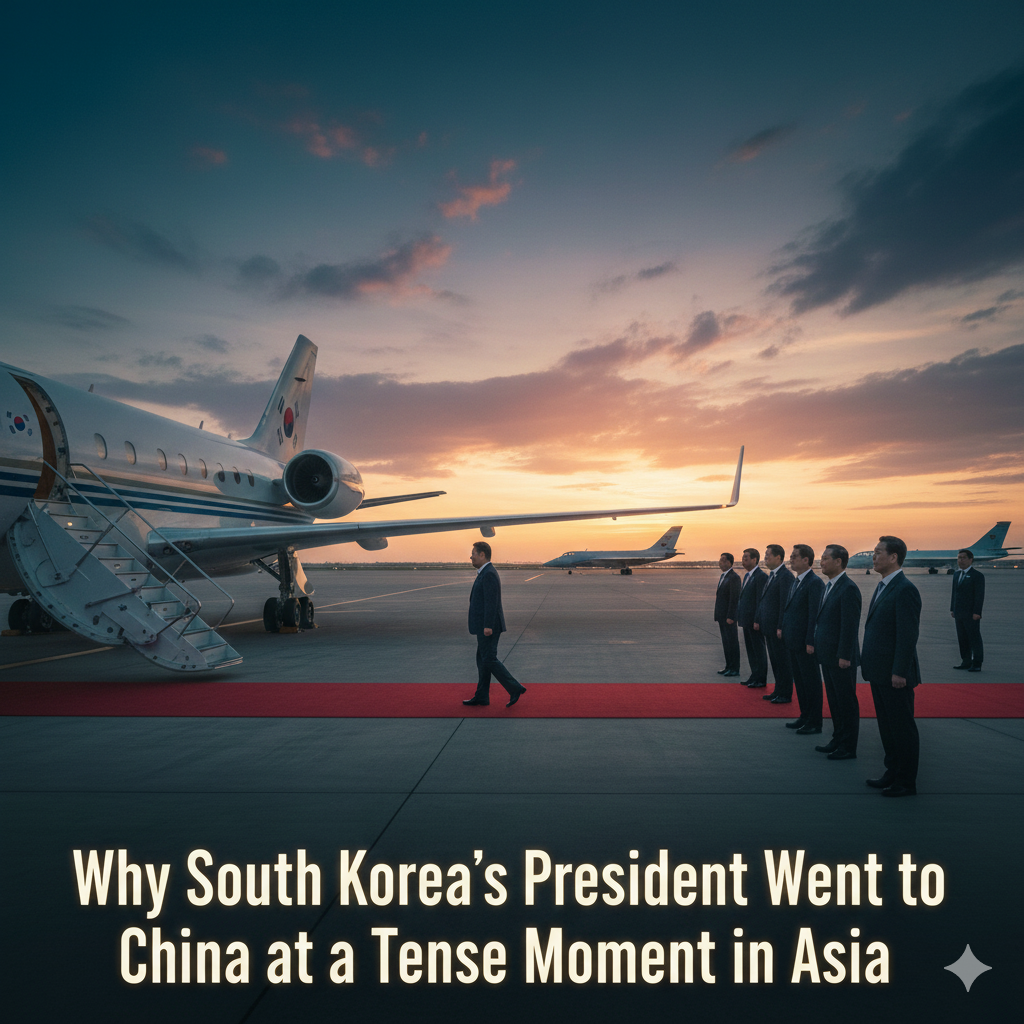
South Korean President Lee Jae-myung’s visit to China is not just another routine foreign trip. It comes at a time when East Asia is facing serious tension, especially because of growing disputes over Taiwan, strained relations between China and Japan, and renewed worries about North Korea’s weapons program. In simple terms, this visit is about calming tensions, strengthening ties, and protecting South Korea’s interests in a very complicated regional situation.
Let’s break down what is really happening, why it matters, and what South Korea hopes to achieve — in clear, straightforward language.
Why This Visit Matters Right Now
President Lee arrived in Beijing for a four-day visit, his first trip to China since becoming president in June. The timing is important. Relations in the region have been uneasy for months, especially after Japan signaled that it might get involved militarily if China takes action against Taiwan, a self-ruled island that China considers part of its territory.
China reacted strongly to such statements. It carried out large military drills near Taiwan, sending a clear warning not just to Taiwan but also to countries like Japan and the United States. Against this tense backdrop, South Korea decided that dialogue was better than silence. Lee’s visit is meant to keep communication open and prevent misunderstandings from turning into bigger problems.
South Korea’s Careful Position Between Big Powers
South Korea is in a tricky position. It is surrounded by powerful neighbors and deeply connected to all of them in different ways.
China is South Korea’s biggest trading partner. A large part of South Korea’s economy depends on exports to China.
The United States is South Korea’s key military ally and helps defend it against threats from North Korea.
Japan, despite historical tensions, is an important regional partner and shares security concerns.
President Lee’s challenge is to maintain good relations with all sides without getting pulled into conflicts that don’t directly serve South Korea’s interests. This visit to China is part of that balancing act.
The Taiwan Issue: Staying Neutral but Clear
One of the most sensitive topics during this visit is Taiwan. China considers Taiwan its sovereign territory, while Taiwan governs itself and has support from the United States and concern from Japan.
During an interview before his trip, President Lee made it clear that South Korea respects the “One-China” policy. This means South Korea officially recognizes China’s position that Taiwan is part of China. This stance is not new, but repeating it now is significant because tensions are high.
At the same time, Lee avoided saying anything that would suggest South Korea would support military action or get involved in a conflict over Taiwan. His message was simple: South Korea wants peace and stability, not confrontation.
Sending a Message of Respect to Beijing
Ahead of his visit, Lee gave an interview to China’s state television, something that was carefully planned. He spoke from the Blue House, South Korea’s presidential office, and emphasized that his government values its relationship with China.
He spoke about mutual respect, saying that healthy relations depend on understanding each other’s concerns. He also praised Chinese President Xi Jinping, calling him a reliable neighbor. These words were clearly meant to build trust and signal that South Korea does not see China as an enemy.
At the same time, Lee acknowledged that there have been past misunderstandings between the two countries. His goal, he said, was to reduce these misunderstandings and take the relationship to a more mature and stable level.
Balancing the U.S. Alliance Without Provoking China
Some people wonder whether improving ties with China might weaken South Korea’s alliance with the United States. Lee addressed this directly.
He made it clear that working closely with the U.S. does not mean South Korea wants conflict with China. From Seoul’s point of view, it is possible — and necessary — to cooperate with Washington on security while also maintaining friendly and productive relations with Beijing.
This approach reflects South Korea’s practical mindset: it cannot afford to choose one side and alienate the other. Instead, it wants to reduce tensions and avoid being dragged into great-power rivalries.
North Korea: A Major Topic Behind Closed Doors
Another major reason for Lee’s visit is North Korea. Pyongyang remains one of the biggest security threats in the region because of its nuclear weapons and missile tests.
South Korea and the U.S. have long urged China to use its influence over North Korea. China is North Korea’s closest ally and main economic supporter. Without Chinese backing, North Korea would struggle to survive.
However, China has often been accused of not fully enforcing international sanctions on North Korea. Beijing sees North Korea as a buffer against U.S. influence and fears that instability there could create bigger problems.
Just before Lee’s visit, North Korea fired several ballistic missiles, reminding everyone how fragile the situation is. During his meetings, Lee is expected to ask China to play a constructive role in encouraging North Korea to return to dialogue and avoid further provocations.
High-Level Meetings with China’s Leadership
During the trip, Lee is scheduled to meet:
President Xi Jinping, for their second meeting in just two months
Zhao Leji, head of China’s legislature
Premier Li Qiang, China’s top government official after Xi
These meetings are meant to cover security issues, economic cooperation, and regional stability. South Korea hopes these talks will lead to practical steps, not just polite statements.
Economic Ties: Benefits for Ordinary People
Beyond politics and security, Lee’s visit also focuses on economic cooperation. South Korea wants stronger trade ties, smoother supply chains, and more cooperation in areas like technology and manufacturing.
Officials have said that Seoul hopes for outcomes that directly benefit ordinary citizens in both countries. This could mean more jobs, more investment, and easier business cooperation.
Economic stability is especially important now, as global markets face uncertainty and regional tensions can easily disrupt trade.
A Push for Peace on the Korean Peninsula
One of Lee’s main goals is to restore calm on the Korean Peninsula. While progress may be slow, South Korea believes that China’s involvement is essential.
Lee has already asked Xi in earlier meetings to help persuade North Korea to return to talks. This visit continues that effort. South Korea knows China alone cannot solve the problem, but without China, any solution becomes much harder.
What This Visit Really Signals
President Lee’s trip to China sends several clear messages:
South Korea prefers dialogue over confrontation
It wants balanced relations with all major powers
It does not want to be dragged into the Taiwan conflict
It seeks China’s help in managing North Korea
It values economic cooperation that helps everyday people
Rather than making bold or dramatic moves, Lee is choosing a calm, steady approach. In a region where emotions and nationalism can easily spiral into conflict, this kind of diplomacy may help prevent things from getting worse.
In Simple Words
South Korea’s president went to China at a tense time because talking is better than fighting. By reassuring China, staying neutral on Taiwan, strengthening economic ties, and pushing for peace with North Korea, Lee Jae-myung is trying to protect his country’s future.
It’s not an easy path, and success is not guaranteed. But in a region full of pressure and uncertainty, South Korea’s message is clear: peace, balance, and cooperation matter more than choosing sides.

Ghananand is the Founder & Chief Editor of NewzStrome. Hailing from Prayagraj, Uttar Pradesh, he brings 1.5 years of hands-on experience in journalism and digital media. He delivers sharp, unbiased, and timely news from India and across the globe. Passionate about investigative reporting, technology, politics, and lifestyle, Ghananand is committed to bringing readers nothing but the truth