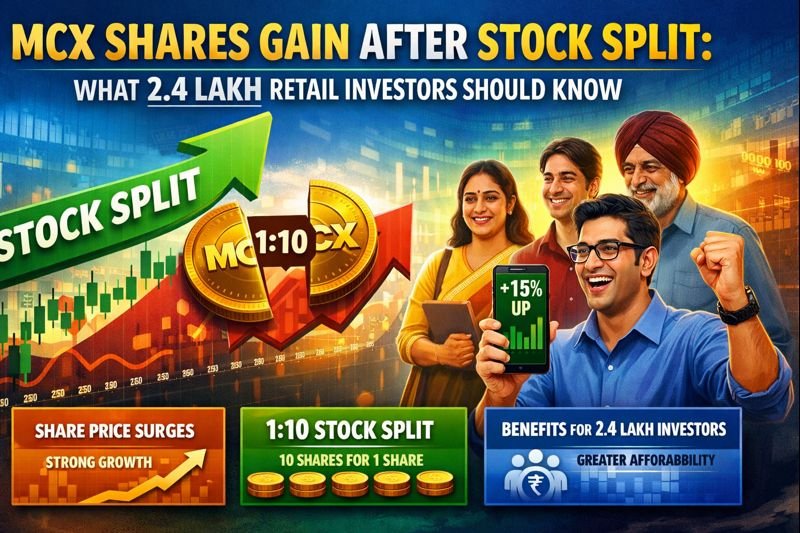
On Friday, January 2, 2026, Multi Commodity Exchange of India (MCX) Ltd. shares increased as the stock started trading adjusted for its newly announced stock split. The market has given the development a lot of attention, especially from the more than 2.4 lakh retail investors who collectively control a sizable share of the business.
Being the first in the company’s history, the stock split represents a significant business milestone for MCX. Market players are keeping a careful eye on the development to see how it affects future liquidity, valuation, and holdings.
MCX Stock Split Explained in Simple Terms
MCX announced a 1:5 stock split, under which:
One equity share of face value ₹10
Was split into five equity shares of face value ₹2 each
This means that while the number of shares held by investors increased, the overall value of their investment remained unchanged. The share price adjusted proportionately to reflect the revised face value.
Such corporate actions are often compared to a bonus issue stock split, as both increase the number of shares in an investor’s portfolio without altering the company’s market capitalisation.
Record Date and Eligibility: Who Benefited?
The company fixed Friday, January 2, 2026, as the record date for the stock split.
Investors who held MCX shares in their demat accounts as of Thursday’s market close were eligible.
Those who purchased MCX shares on the record date or later were not eligible for the split benefit.
Example:
If an investor held 50 MCX shares before the record date:
After the split, those shares became 250 shares
The per-share price adjusted automatically
No action was required from investors, as the revised share count was credited directly to demat accounts.
Why Companies Opt for Stock Splits
A stock split does not create immediate wealth, but it serves several strategic purposes:
Makes shares more affordable for retail investors
Improves trading liquidity
Encourages broader market participation
Enhances long-term accessibility of the stock
MCX’s decision to announce a stock split comes at a time when interest in market infrastructure and exchange-related stocks is rising across India.
MCX Share Price Performance After the Split
Following the adjustment, MCX shares were trading around 2.5% higher, near the ₹2,254 mark during Friday’s session.
The positive movement indicates that the market has absorbed the stock split smoothly, with no confusion or negative sentiment. Historically, stocks with strong fundamentals often stabilise quickly after such corporate actions.
MCX’s Unique Shareholding Structure
One of the most distinctive aspects of MCX is that the company does not have any promoter shareholding.
As per the September quarter shareholding data:
Mutual Funds hold over 37% stake, making them the largest shareholders
Kotak Mahindra Bank owns nearly 15% stake, valued at about ₹8,400 crore at current prices
Retail investors:
Over 2.4 lakh shareholders
Holding a combined 15.3% stake
This high level of institutional and retail participation makes MCX a closely watched stock in the Indian markets.
What Retail Investors Should Understand
For retail shareholders, the stock split offers practical benefits:
Increased number of shares improves selling flexibility
Lower per-share price helps in incremental investing
No dilution of ownership or intrinsic value
Better liquidity in daily trading
However, investors should remember that a stock split—or a bonus issue stock split comparison—does not change business fundamentals. Long-term performance will depend on earnings growth, volumes, and regulatory stability.
Bonus Issue vs Stock Split: Key Difference
Investors often confuse a bonus issue stock split, but the two are structurally different:
Stock Split: Reduces face value and increases share count
Bonus Issue: Issues free shares from reserves
In both cases, the market capitalisation remains unchanged, and the benefit lies mainly in liquidity and accessibility. MCX’s recent action is strictly a stock split, not a bonus issue.
Institutional Confidence: Morgan Stanley’s Upgrade
Adding to the positive sentiment, Morgan Stanley recently upgraded MCX shares, raising its price target by over 66%.
The brokerage cited several factors:
MCX’s dominant position in commodity derivatives
Expected growth in trading volumes
Expansion of India’s financial markets
Strong operating leverage
Such upgrades from global institutions often reinforce confidence among long-term investors.
MCX’s Role in India’s Financial Ecosystem
MCX plays a crucial role in India’s commodity markets by providing:
Transparent price discovery
Risk management tools for businesses
Hedging opportunities for traders and producers
As participation in commodities and derivatives trading grows, MCX is expected to remain a key pillar of India’s financial infrastructure.
Risks Investors Should Keep in Mind
Despite the positive developments, investors should remain mindful of potential risks:
Regulatory changes in derivatives trading
Market volatility affecting volumes
Competition from other exchanges
Global commodity price fluctuations
These factors can influence MCX’s performance over the medium to long term.
Why This Story Matters for Google Discover Readers
Stories like MCX’s stock split perform well on Google Discover because they are:
Timely and market-relevant
Directly impact retail investors
Backed by data and institutional views
Easy to understand for non-experts
Clear explanations help readers make informed decisions rather than react to headlines.
Final Takeaway for Investors
The adjustment of MCX shares following its first-ever stock split is a structurally positive move aimed at improving liquidity and accessibility. While often compared to a bonus issue stock split, investors should understand that such corporate actions are not value-creating events on their own.
For the 2.4 lakh retail shareholders, the focus should remain on MCX’s fundamentals, trading growth, and long-term prospects rather than short-term price movements.
Disclaimer: This article is for informational purposes only and does not constitute investment advice.

Ghananand is the Founder & Chief Editor of NewzStrome. Hailing from Prayagraj, Uttar Pradesh, he brings 1.5 years of hands-on experience in journalism and digital media. He delivers sharp, unbiased, and timely news from India and across the globe. Passionate about investigative reporting, technology, politics, and lifestyle, Ghananand is committed to bringing readers nothing but the truth