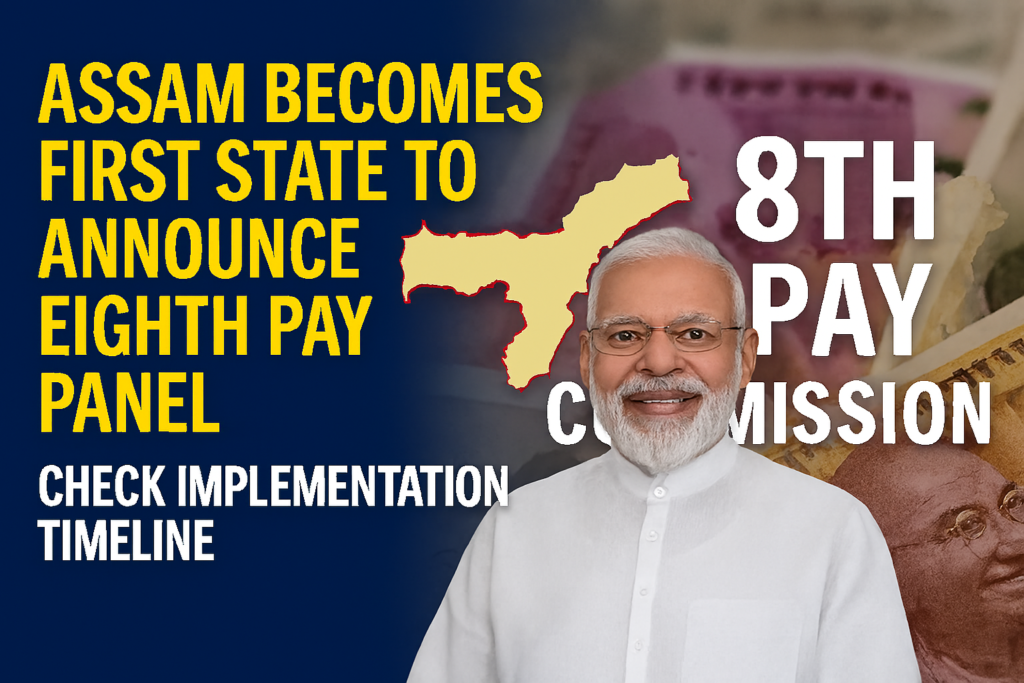
A major and long-awaited development has emerged around the 8th Pay Commission, bringing fresh attention to salary revision discussions for government employees across India. In a significant move, the Assam government has officially announced the formation of the 8th State Pay Commission, making it the first state in the country to take this step.
The announcement has sparked nationwide interest, especially among central and state government employees who have been eagerly awaiting updates after the conclusion of the 7th Pay Commission on December 31, 2025.
Here is a detailed look at the 7 biggest updates related to the 8th Pay Commission, what Assam’s decision means, and when implementation is likely.
1. Assam Becomes the First State to Form the 8th Pay Commission
The Government of Assam has taken a historic step by approving the formation of the 8th State Pay Commission, becoming the first state in India to do so.
While the 8th Pay Commission at the central level has already received approval and Terms of Reference (ToR), no state had announced its own pay commission until now. Assam’s early decision has set a precedent and placed the state at the forefront of employee-centric governance.
This move is being widely welcomed by government employees and policy observers alike.
2. Official Announcement by CM Himanta Biswa Sarma

Assam Chief Minister Himanta Biswa Sarma, while addressing an official gathering in Guwahati, announced the establishment of the 8th Pay Commission.
He emphasized that although the Central Government has already initiated work on the framework for the 8th Central Pay Commission, individual states must take proactive steps to ensure that their employees benefit without delay.
Highlighting its significance, the Chief Minister described the creation of the 8th State Pay Commission as a milestone in advancing employee welfare, strengthening transparency, and promoting progressive governance.
3. Former Chief Secretary Shubhas Das Appointed as Chairman
The Assam government has appointed former Chief Secretary Shubhas Das as the Chairman of the 8th Pay Commission for the state.
With decades of administrative experience, Shubhas Das is expected to lead the commission in drafting realistic and balanced recommendations. His leadership is seen as crucial in addressing employee expectations while maintaining fiscal discipline.
The commission will study salary structures, allowances, pensions, and other service conditions under the 8th Pay Commission framework.
4. 7th Pay Commission Ends, Paving the Way for the 8th Pay Commission
One of the key reasons behind growing discussions around the 8th Pay Commission is the official conclusion of the 7th Pay Commission on December 31, 2025.
With the end of the seventh pay cycle, government employees are now in a transition phase. Historically, pay commissions are revised every ten years, making the 8th Pay Commission a crucial milestone.
The Assam government’s move comes at a time when employees across the country are expecting clarity on salary hikes, allowances, and fitment factors.
5. What Assam’s Decision Means for Central Government Employees
Although Assam’s announcement applies specifically to state government employees, it has broader implications for central government staff awaiting updates on the 8th Central Pay Commission.
The Central Government approved the 8th Pay Commission and its Terms of Reference in early 2025, followed by formal notifications around November 2025. However, implementation of revised salaries is still pending.
Historically, a pay commission takes around 18 months to submit its recommendations. This means that while expectations are high, immediate implementation should not be assumed.
6. When Will the 8th Pay Commission Be Implemented? Expert Opinions
Experts have offered cautious timelines regarding the implementation of the 8th Pay Commission.
According to Madan Sabnavis, Chief Economist at Bank of Baroda, the recommendations of the 8th Pay Commission could be implemented as late as FY 2027–28 or FY 2028–29, depending on economic conditions and government finances.
Other experts point out that since the commission was approved and notified in 2025, recommendations may be finalized by late 2026 or early 2027, followed by phased implementation.
For Assam, timelines may vary based on when the 8th State Pay Commission submits its report and how quickly the state government approves it.
7. Why the 8th Pay Commission Announcement Is a Big Signal for Other States
Assam’s decision to form the 8th Pay Commission is being viewed as a strong signal for other state governments.
As inflation and cost of living continue to rise, pressure is building on states to address employee salary concerns. Assam’s early action could encourage other states to initiate similar steps instead of waiting for central implementation.
This development has also renewed employee expectations regarding improved pay structures, allowances, and retirement benefits under the 8th Pay Commission.
Key Expectations from the 8th Pay Commission
Although official recommendations are yet to be drafted, employees and unions are already discussing expectations from the 8th Pay Commission, including:
Increase in minimum basic salary
Revision of fitment factor
Changes in DA merger formula
Rationalisation of allowances
Improvements in pension benefits
However, experts caution that expectations must be balanced with fiscal realities.
What Government Employees Should Do Now
Employees awaiting benefits under the 8th Pay Commission should remain patient and focus on official updates rather than speculation.
Key things to watch include:
Progress reports from the 8th State Pay Commission of Assam
Official statements from the Central Government on timelines
Any draft recommendations released for public feedback
Union discussions and government responses
Understanding the process will help employees manage expectations more realistically.
Why the 8th Pay Commission Process Takes Time
The process of the 8th Pay Commission entails a thorough examination of:
Government earnings and outlays
- Trends in inflation
- Equal pay for all departments
- effect on the budget deficit
- Long-term viability
Implementation typically requires multiple rounds of review and approval due to these complications, which frequently cause delays.
Final Takeaway on the 8th Pay Commission
The formation of the 8th Pay Commission by Assam marks a landmark moment in India’s salary revision cycle. While immediate implementation is unlikely, the announcement has reignited hope and set the stage for broader reforms.
For now, the focus remains on when recommendations will be submitted and how governments balance employee expectations with economic realities under the 8th Pay Commission.
Disclaimer:
This narrative is solely intended for educational reasons. The opinions and suggestions are not those of Mint, Before making any financial decisions, we suggest investors to speak with qualified specialists. ( THIS POST IS FOR EDUCATIONAL PURPOSE ONLY)