Imagine you’ve been diligently saving and investing a part of your salary every month for years, betting on your country’s future. Then, you find out the rules for how your profits are taxed have changed, making your long-term commitment feel less worthwhile. That’s the frustration simmering among many Indian investors right now, and it’s prompting fund managers and politicians to speak directly to the Finance Minister.
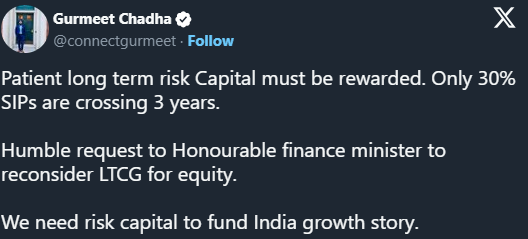
The core issue is a simple plea: please don’t penalize patience. Gurmeet Chadha, a respected fund manager, recently shared a startling fact that highlights the problem: only 3 out of every 10 Systematic Investment Plans (SIPs) in India manage to cross the three-year mark. If you wants to know about other incoming IPO of India you should go through it .In a country dreaming of an economic boom fueled by its own people’s savings, that’s a worrying sign. His “humble request” to Finance Minister Nirmala Sitharaman is to take another look at the Long-Term Capital Gains (LTCG) tax, because patient, long-term risk capital needs to be rewarded, not taxed heavily.
So, What Exactly Changed with the Taxes?

Let’s break down the tax changes that have everyone talking. Back in July 2024, the government decided to tidy up the tax rules for investments. The idea was to bring more uniformity, but for many common investors, the changes felt like a hike.
The long-term capital gains tax on profits from stocks and equity mutual funds (held for more than a year) was increased from 10% to 12.5%. More significantly, the government removed the benefit of “indexation” for most assets. Indexation is a way to adjust your purchase price for inflation, so you only pay tax on your real profit, not on the part of the gain that was just because money lost its value over time. Taking that away means you could end up paying tax on paper profits that aren’t really there, which hits long-term savers the hardest.
The Big Picture: Why This Matters Now More Than Ever

This isn’t just a theoretical debate about tax percentages. It’s happening at a crucial moment for Indian markets. 2025 has seen foreign investors pulling out money from Indian stocks at a record pace. We’re talking about a staggering withdrawal of over ₹1.6 lakh crore. For years, we looked to foreign investment as a sign of confidence, but that money has proven to be “fair-weather friends,” quick to leave when global winds change direction.
So, who held the fort? Indian households like yours and mine. While foreign investors were exiting, domestic investors—ordinary people through mutual fund SIPs, pension money, and insurance funds—poured in a historic ₹7 lakh crore. This wasn’t just a number; it was a statement. It showed that Indian savings have matured into the bedrock of our own financial markets, providing stability when it was needed most. As AAP MP Raghav Chadha pointed out, it’s the Indian investor who “comes to the rescue of the stock market.”
The Heart of the Argument: Patience Should Pay
This brings us to the central complaint. Critics argue that the current tax system fails to distinguish between a quick speculative trade and genuine, long-term faith in a company. By removing indexation and raising rates, the system inadvertently treats a decade-long investment almost the same way it treats a one-year gamble. It creates uncertainty—how can you plan for a 20-year goal if the tax rules might change every few budgets?
The plea from experts is grounded in a basic economic principle: if you want to encourage something, don’t tax it heavily. We tax consumption (like buying goods) because we want to promote savings and investment instead. The argument is that by over-taxing investment gains, especially the long-term ones, we are discouraging the very “patient capital” that builds roads, funds startups, and helps companies grow. This is the capital that funds “India’s growth story,” as Chadha put it.
A Shift in How India Saves
This debate is also tied to a silent revolution in our saving habits. For generations, the safe bank fixed deposit was the king. Now, more and more people are choosing the stock market for better returns. While this is great for deepening our financial markets, it also means bank deposits are growing slower. This can make loans more expensive for small businesses, creating a tricky balancing act for the economy.
Some suggestions on the table include not just reconsidering equity taxes but also offering tax relief on long-term bank deposits to keep that channel healthy. The goal is a balanced system that encourages all forms of responsible saving.
In the end, this is more than a policy tweak. It’s a question of signal. As India stands at an economic crossroads, powered increasingly by its own citizens’ savings, does its tax code salute those who stay invested for the long haul, or does it quietly take a heavier share from them? The call to reconsider LTCG is ultimately about choosing to nurture the very patience that builds nations.
Disclaimer:
This narrative is solely intended for educational reasons. The opinions and suggestions are not those of Mint, Before making any financial decisions, we suggest investors to speak with qualified specialists. ( THIS POST IS FOR EDUCATIONAL PURPOSE ONLY)